



Changing bleeding: a hormonal signal, not an inevitability
During perimenopause, the ovaries no longer ovulate consistently. Without ovulation, progesterone — the hormone that regulates and stabilizes the cycle — declines first, while estrogen levels continue to fluctuate. The result: an endometrium that thickens irregularly and sheds in fragments, causing prolonged bleeding, heavy periods, or spotting between cycles.
In this article, we explain why these changes occur, how to distinguish normal bleeding from a warning sign, what natural and medical approaches are available, and when to consult a healthcare professional. This article is for informational purposes only and does not replace medical advice.
Why bleeding changes during perimenopause

Perimenopause — the hormonal transition that begins on average around ages 45–47 and lasts 4 to 8 years — profoundly disrupts the menstrual cycle. And the first change most women notice concerns precisely their bleeding. To understand what is happening, we need to revisit the hormonal mechanics. If you would first like to determine exactly what stage you are in, our perimenopause vs. menopause guide can help.
🧬 The hormonal mechanism involved
During a normal cycle, ovulation triggers the production of progesterone, the hormone that stabilizes the endometrium (the uterine lining) and prepares for orderly periods. During perimenopause, ovulation becomes irregular and then increasingly rare. When ovulation does not occur, there is not enough progesterone produced.
Meanwhile, estrogen—although declining overall—continues to fluctuate, sometimes at higher-than-normal levels. Under the influence of this estrogen, unopposed by progesterone, the endometrium continues to thicken excessively, then detaches irregularly and over an extended period instead of being properly renewed with each cycle.
Without ovulation, there is no corpus luteum and no progesterone. The endometrium thickens under the effect of estrogen alone and detaches in a fragmented and unpredictable way, causing prolonged bleeding or continuous spotting.
Paradoxically, estrogen levels can reach very high peaks during perimenopause before dropping sharply. These hormonal roller coasters explain the alternation between very heavy periods and periods of light spotting.
Uterine fibroids (benign tumors of the uterine muscle) and endometrial polyps (growths of the uterine lining) are common at this age and can increase the volume and duration of bleeding. They require diagnosis by ultrasound.
An excess of adipose tissue increases peripheral estrogen production, intensifying the imbalance. Chronic stress, certain medications (NSAIDs, anticoagulants), and thyroid disorders can also alter the bleeding pattern.
The systematic review published in Menopause Review (Daan & Fauser, 2015) confirms that abnormal uterine bleeding affects up to 30% of women during the menopausal transition. The authors emphasize that the most common cause is chronic anovulation, with the endometrium exposed to unopposed estrogen stimulation. The recommended first-line treatment is cyclic progesterone or a levonorgestrel-releasing IUD, combined with a transvaginal ultrasound evaluation to rule out structural pathology.
Normal or abnormal bleeding: how to tell the difference

During perimenopause, the cycle can become completely unpredictable. A period that lasts 10 days one month, then 3 days the next. Brown spotting between two cycles. Flow alternating between heavy and almost nonexistent. The variability itself is normal. But some signs require medical attention.
✅ What is generally normal
The following variations are part of the hormonal transition and are not usually cause for concern in the absence of other symptoms:
- cycles that become shorter (24 days) or longer (40 days or more)
- periods that last longer than usual (up to 7–8 days)
- flow that varies from one cycle to the next
- occasional small clots
- light spotting between periods
🚨 Warning signs not to ignore
However, some bleeding requires prompt medical attention. It is important to identify it so you can act in time.
Changing protection every 1–2 hours for more than 2 hours
Bleeding that persists for more than 10 consecutive days
Exhaustion, dizziness, shortness of breath—possible signs of iron-deficiency anemia
Bleeding after sexual intercourse—always report it to your doctor
One of the most useful tools for your doctor is a bleeding diary: dates, duration, intensity (light, moderate, heavy), presence of clots, and associated symptoms (pain, fatigue, dizziness). Several apps are available to make tracking easier. This information allows the gynecologist to quickly identify an abnormal pattern and make a more accurate diagnosis.
Diagnosis: recommended examinations
When bleeding is persistent or concerning, a medical assessment helps identify the precise cause and rule out any serious condition. Here are the examinations usually recommended, step by step.
The doctor assesses cycle length, the amount of blood lost, medical history, and current treatments. Your menstrual diary is invaluable at this stage—it provides a clear picture of what your body is going through.
This noninvasive examination assesses endometrial thickness and detects fibroids, polyps, or ovarian cysts. It is the first-line examination for any abnormal bleeding during perimenopause.
Testing FSH, LH, estradiol, and progesterone helps determine the transition phase. Thyroid function tests and a complete blood count (CBC) complete the evaluation—the latter to screen for possible anemia related to blood loss.
Depending on the results, the gynecologist may prescribe a hysteroscopy (direct visualization of the uterine cavity) or an endometrial biopsy to rule out atypical hyperplasia or any other condition requiring specific follow-up.
Heavy and prolonged bleeding during perimenopause can lead to an iron deficiency (iron-deficiency anemia), often silent at first. Persistent fatigue, shortness of breath during exertion, paleness, and difficulty concentrating are signs that should prompt you to check your ferritin level. Chronic fatigue attributed to “age” sometimes conceals anemia that can be completely corrected. If you recognize other symptoms related to this transition, our article on perimenopausal brain fog may provide useful information.
Natural and medical solutions

There are several levels of response to perimenopausal bleeding, ranging from nutritional and herbal approaches to medical solutions. The most effective approach often combines several strategies simultaneously.
🌿 Herbal medicine: plants that support hormonal balance
Some medicinal plants have encouraging scientific evidence for supporting hormonal transition and modulating bleeding. They are not intended to replace medical advice, but may provide valuable complementary support.
🩺 Medical options
If natural approaches are not enough or if the bleeding significantly affects quality of life, several medical options are available. They should be discussed individually with a gynecologist.
The prescription of micronized natural progesterone (10 to 14 days per cycle) compensates for the progesterone deficiency, stabilizes the endometrium, and establishes regular periods. It is the recommended first-line treatment according to medical societies.
The levonorgestrel-releasing intrauterine device releases a progestogen locally, considerably reducing bleeding — by up to 90% according to studies. It also provides contraception, which is useful until menopause is confirmed.
In the presence of large fibroids, recurrent polyps, or atypical endometrial hyperplasia, targeted interventions may be offered: hysteroscopic resection of polyps, endometrial ablation, or, in the most complex cases, hysterectomy. These decisions are made on a case-by-case basis, after a complete assessment.
Micronutrition and targeted supplementation
Beyond herbal medicine, certain micronutrients play an essential role in hormone regulation and compensating for losses associated with heavy bleeding. A suitable diet is the first approach—but during this phase of high metabolic demand, smart supplementation can make a real difference.
Heavy and prolonged periods increase iron loss. A ferritin level below 30 µg/L (even with normal hemoglobin) can cause fatigue, hair loss, weakened immunity, and cognitive difficulties. Iron bisglycinate supplementation—a better-tolerated form—is often necessary, ideally accompanied by vitamin C to optimize absorption.
Vitamin D3 plays a role in immune system modulation and bone metabolism—two aspects weakened by the hormonal transition. Combined with vitamin K2, it promotes calcium deposition in the bones rather than the arteries. For more information, see our article on vitamin D3 and its cofactors.
Magnesium is involved in more than 300 enzymatic reactions, including nervous system regulation and uterine muscle relaxation. B vitamins (B6, B9, B12) support hormone metabolism, serotonin production, and stress resilience—often exacerbated by cycle disturbances.
The intestine participates in estrogen metabolism through the estrobolome (a group of intestinal bacteria capable of metabolizing estrogen). An imbalanced microbiota may contribute to excess circulating estrogen. Targeted probiotic strains, such as those in Nutremys Premium Encapsulated Probiotics, can help support this balance. Discover our complete guide to probiotics and gut flora.
The estrobolome refers to the collection of gut microorganisms capable of producing a key enzyme, beta-glucuronidase, which influences the reabsorption of conjugated estrogens in the digestive tract. Gut dysbiosis—promoted by stress, antibiotics, or a low-fiber diet—can increase this enzyme’s activity, leading to a relative excess of estrogens in the bloodstream. This phenomenon exacerbates the hormonal imbalance characteristic of perimenopause and may intensify bleeding (Plottel & Blaser, The Journal of Clinical Endocrinology & Metabolism, 2011).
If you experience several of these signs, targeted nutritional support may be particularly helpful:
- persistent fatigue despite adequate sleep
- hair loss or brittle nails
- increased irritability
- chronic bloating
- drier and less radiant skin
- difficulty recovering after exercise
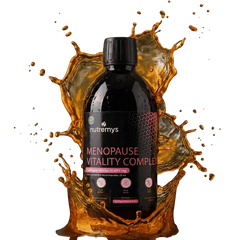
Nutremys’s Menopause Vitality Complex combines 31 active ingredients—including marine collagen, phytoestrogens (red clover, dong quai, maca), magnesium, vitamins D3, K2, C, and E, and a complete B-complex—in a highly bioavailable liquid formula.
Guide based on bleeding intensity

The most suitable approach depends on the frequency, intensity, and impact of bleeding on your daily life. This guide helps you assess your situation and identify the next steps.
Irregular
Persistent
Debilitating
The food choices you make during this period influence how you will navigate your transition. Choose foods rich in iron (lentils, spinach, lean red meat), omega-3s (sardines, flaxseeds) for their anti-inflammatory effect, and fiber to support the elimination of excess estrogen through intestinal transit. Moderate physical activity—walking, yoga, swimming—helps regulate hormones and manage weight, a direct factor in estrogen balance. For more comprehensive nutritional advice tailored to this period, see our guide to essential supplements after age 50.
FAQ — Frequently asked questions about bleeding during perimenopause
doi.org/10.5114/pm.2015.49991
inserm.fr/dossier/menopause
doi.org/10.1210/jc.2011-1508
doi.org/10.1002/ijgo.12666
has-sante.fr
doi.org/10.3390/nu16010001



The information shared on this blog is for educational and informational purposes only. It does not replace medical consultation, diagnosis or treatment prescribed by a healthcare professional. If you have symptoms, are undergoing treatment or are pregnant, consult your doctor before modifying your diet or starting supplementation. Nutremys LAB food supplements should not replace a varied, balanced diet or a healthy lifestyle.
