


Vitamin D3: widespread deficiency, documented consequences
Around 80% of Europeans have insufficient vitamin D levels, according to EFSA data. In France, the situation is worsened by geography: between October and March, UVB rays are insufficient to trigger cutaneous D3 synthesis at all French latitudes. Even in summer, most people do not build up enough reserves to get through the winter without becoming deficient.
This guide explains why vitamin D3 is not like other vitamins, how it works in the body, which signs indicate a deficiency, and how to structure supplementation based on the available evidence.
Vitamin D3 or D2: a distinction that matters
"Vitamin D" is a generic term covering two distinct molecules with different properties. Vitamin D2 (ergocalciferol) is derived from plants and fungi—it occurs in certain fungi exposed to UV light. Vitamin D3 (cholecalciferol) is the form naturally synthesized by human skin under the effect of UVB rays, and the form found in animal products. This is not merely a formulation detail: several comparative studies show that D3 is 2 to 3 times more effective than D2 at raising and maintaining serum 25(OH)D levels—the form measured in blood tests as an indicator of actual vitamin D status.
Vitamin D3 is technically a prohormone rather than a conventional vitamin. Once ingested or synthesized in the skin, it is converted in the liver into 25(OH)D (the storage form), then in the kidneys and peripheral tissues into calcitriol (1,25(OH)₂D), its biologically active form. Calcitriol acts by binding to VDR (Vitamin D Receptor) receptors found in almost all tissues—which explains its systemic influence far beyond bone metabolism alone.

Ingested or skin-synthesized vitamin D3 is hydroxylated in the liver (forming 25(OH)D) and then in the kidneys (forming active calcitriol). This calcitriol binds to VDR receptors present in immune, muscle, cardiac, brain, intestinal, and bone cells. It modulates the expression of hundreds of genes — hence the diversity of its biological effects, which go far beyond calcium absorption alone.
6 scientifically documented benefits
These six areas are those for which the scientific evidence is the most consistent and directly relevant to active women aged 40 and over. EFSA has approved official claims for four of them under EU Regulation No. 432/2012.

Bone health — EFSA-approved claim
Vitamin D3 is essential for the intestinal absorption of calcium and phosphorus. Without sufficient D3 levels, even a high calcium intake does not result in adequate bone density — calcium cannot effectively cross the intestinal wall. This function is particularly critical during menopause, when bone density loss accelerates. EFSA explicitly recognizes vitamin D's contribution to maintaining normal bones.
Normal functioning of the immune system — EFSA-approved claim
VDR receptors are present on macrophages, T and B lymphocytes, and dendritic cells. Vitamin D3 modulates the innate and adaptive immune response — strengthening defenses against infectious agents while modulating excessive autoimmune responses. Insufficient levels are associated with increased vulnerability to respiratory infections and slower recovery.
Normal muscle function — EFSA-approved claim
Vitamin D3 directly contributes to muscle protein synthesis and the contractility of muscle fibers. A meta-analysis of more than 30,000 participants confirms a 19% reduction in the risk of falls among older people taking supplements. Diffuse muscle weakness is one of the first clinical signs of insufficient levels, and one of the first to improve with appropriate supplementation.
Maintenance of normal teeth — EFSA-approved claim
Through its effects on calcium metabolism and mineralization, vitamin D3 contributes to maintaining the density and integrity of tooth enamel and the alveolar structure. Insufficient levels are associated with increased susceptibility to cavities and periodontal disease.
Mood regulation and mental health
VDR receptors are present in the hippocampus, prefrontal cortex, and areas involved in emotional regulation. D3 contributes to the synthesis of serotonin and dopamine. A 2020 meta-analysis (7,534 participants) confirms a measurable effect of vitamin D supplementation on depressive symptoms, particularly in the context of seasonal depression. These data do not make D3 an antidepressant, but they support maintaining an optimal level, especially in winter.
Metabolic regulation
Vitamin D3 modulates insulin sensitivity and glucose metabolism via VDR receptors in pancreatic beta cells. Epidemiological data show an inverse association between D3 levels and insulin resistance—a mechanism that is particularly relevant during menopause, when insulin resistance naturally increases.
Signs of insufficient levels
Vitamin D3 deficiency is often silent for months. The symptoms are nonspecific—easily attributed to stress, overwork, or simple aging. Here is the usual progression of uncorrected chronic deficiency.
Persistent exhaustion that does not improve with rest—often the first noticeable sign
Muscle aches, nighttime cramps, and a feeling of joint weakness
Colds, frequent upper respiratory tract infections, and slow recovery after each episode
Irritability, underlying anxiety, and depressive symptoms worsening in autumn and winter
Several characteristics increase the risk of deficiency:
- darkly pigmented skin (melanin reduces cutaneous synthesis)
- being over 60 (cutaneous synthesis capacity decreases by 75% after age 70)
- overweight (fat-soluble D3 becomes sequestered in adipose tissue)
- indoor work
- consistent use of high-SPF sun protection
- living anywhere in France from October to March
A blood test for 25(OH)D is the only way to determine your status precisely—it is covered by insurance with a doctor's prescription for at-risk patients.
Sources: sunlight, diet, supplements

Cutaneous synthesis—the primary source
This is the most effective and natural approach. In summer, 15 to 30 minutes of exposing the arms and legs to the midday sun produces between 10,000 and 20,000 IU of vitamin D3—without applying sunscreen (which reduces synthesis by 99% at SPF 15). The problem is structural: in France, UVB levels are insufficient from September to April for any effective synthesis. Even adequate summer sun exposure is not enough to build reserves that last through the entire winter for most people.
Diet — a limited contribution
Dietary sources of vitamin D3 are few and levels are low. Fatty fish are the best source, but 100 g of cooked salmon provides only 600 to 800 IU — a fraction of the 1,500 to 2,000 IU considered the optimal daily intake. Diet alone cannot maintain an optimal level.
| Food | Vitamin D3 (per 100 g) | Note |
|---|---|---|
| Cod liver oil | ≈ 10,000 IU | Most concentrated source; use with care |
| Herring (smoked/marinated) | ≈ 1,600 IU | Good source, easy to include |
| Salmon (cooked) | ≈ 600–800 IU | + omega-3 EPA/DHA |
| Mackerel (cooked) | ≈ 360 IU | Accessible and affordable |
| Sardines (canned) | ≈ 270 IU | Practical, good source of calcium |
| Egg yolk | ≈ 40 IU | Modest but consistent contribution |
Supplementation — the most reliable solution
For most of the French population, D3 supplementation is the only way to maintain an optimal level between October and April. It does not replace sensible sun exposure in summer, but complements what neither the sun nor diet can provide throughout the year.
How to supplement correctly

Vitamin D3 (cholecalciferol) is 2 to 3 times more effective than D2 at raising and maintaining serum levels. Comparative studies are clear on this point. The label should state “cholecalciferol” or “vitamin D3” — not “ergocalciferol” or simply “vitamin D.” For vegans, forms of D3 extracted from lichen (Cladonia rangiferina) are available and offer the same efficacy.
Vitamin D3 is fat-soluble — it is absorbed with dietary fat. Taking it with a meal containing olive oil, fish, nuts, or avocado can increase its absorption by 32 to 50% compared with taking it on an empty stomach. The time of day matters less than daily consistency and the presence of dietary fat.
Vitamin K2 activates two key proteins — osteocalcin (which binds calcium in the bones) and MGP (which prevents it from depositing in the arteries). Without sufficient K2, high-dose D3 supplementation may promote tissue hypercalcemia. The D3 + K2 combination is recommended for people taking more than 1,000 IU of D3 per day over the long term.
The official daily intake recommended by ANSES (600–800 IU for adults) is considered insufficient to maintain an optimal level by many experts. The Endocrine Society recommends 1,500 to 2,000 IU per day to achieve a serum level ≥ 30 ng/mL. In cases of confirmed deficiency documented by testing, a doctor may prescribe higher therapeutic doses for a limited period. The EFSA-established upper safe limit is 4,000 IU per day for healthy adults.
Seasonal supplementation from October to March, even at a high dose, is not enough to maintain an optimal level continuously—the levels in the blood drop quickly after stopping. A moderate daily intake (1,000 to 2,000 IU) year-round, adjusted according to summer sun exposure, is more effective than intensive winter supplementation. Consistency produces more stable levels than stop-and-restart cycles.
Vitamin D3 toxicity (hypervitaminosis D) is possible but rare, and only occurs with very high doses taken over a prolonged period—generally above 10,000 IU per day for several months. It manifests as hypercalcemia with nausea, muscle weakness, and confusion. At common doses of 1,000 to 4,000 IU per day, the risk is nonexistent for a healthy adult. If in doubt, a 25(OH)D blood test remains the only reliable indicator of your actual status.
Vitamin D3 is included
in our complete formula.
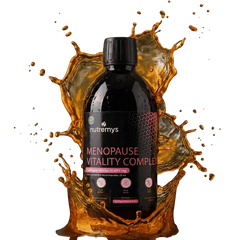
Nutremys Menopause Vitality Complex combines vitamin D3, 10,000 mg of marine collagen, magnesium, and phytoestrogens in a liquid formula with optimal bioavailability—designed for active women aged 45+.
See Menopause Vitality Complex →Frequently asked questions about vitamin D3
The information shared on this blog is for educational and informational purposes only. It does not replace medical consultation, diagnosis or treatment prescribed by a healthcare professional. If you have symptoms, are undergoing treatment or are pregnant, consult your doctor before modifying your diet or starting supplementation. Nutremys LAB food supplements should not replace a varied, balanced diet or a healthy lifestyle.
