






What you are about to read in this article
Weight management after age 40 follows different biological rules from those of a 25-year-old woman. Insulin resistance increases, muscle mass declines, resting metabolism slows, and the drop in estrogen during menopause promotes abdominal fat storage. Conventional low-calorie diets, poorly suited to this reality, often worsen the situation by accelerating muscle loss.
This article presents a physiology-based approach: understanding what is really happening in the body, structuring the diet accordingly, incorporating movement appropriately—and using plants whose properties have been documented in this specific context.
This article is for informational purposes only. In cases of clinical overweight or metabolic conditions, personalized medical monitoring is essential.
What changes in the body after age 40
Understanding why weight is redistributed after age 40—and particularly during menopause—is the first step toward acting appropriately rather than blindly.
The drop in estrogen profoundly alters fat metabolism. Estrogen promoted peripheral fat storage (hips, thighs)—a metabolically more neutral form of storage. Its disappearance promotes abdominal visceral fat storage, which is directly associated with insulin resistance, low-grade chronic inflammation, and cardiovascular risk. This is not a matter of a diet having gone off track—it is a hormonal change with documented metabolic consequences.
Insulin resistance also increases: cells respond less effectively to insulin, which increases the tendency to store carbohydrates as fat rather than use them as fuel. This phenomenon explains recurring cravings, post-meal energy crashes, and weight gain even without an increase in calorie intake.
Finally, sarcopenia (age-related loss of muscle mass) slows resting metabolism—since muscle is the tissue that consumes the most energy at rest. Losing muscle mass without replacing it, as most conventional low-calorie diets do, is therefore counterproductive in the long term.

Before changing your diet, it is useful to objectively assess your actual intake. Waist circumference is a more relevant indicator than weight alone for assessing visceral fat: a waist circumference greater than 88 cm in women is associated with increased metabolic risk according to WHO recommendations. A medical checkup including fasting blood glucose and a lipid panel helps put these data into context.
Nutrition: principles that respect physiology
A diet adapted to the physiology of women aged 40 and over is not a diet in the restrictive sense of the term. It is a thoughtful structure built around a few biological principles that make a difference over time.

Stabilizing blood sugar—the number-one priority
Insulin resistance makes blood sugar spikes the primary enemy of body composition after 40. Meals built around a base of non-starchy vegetables, a quality protein, and a source of fiber (legumes, whole grains) keep blood sugar stable for several hours—which mechanically reduces cravings and fat storage.
Protein: the most underestimated variable
Adequate protein intake (1.2 to 1.6 g/kg/day) preserves muscle mass during a calorie deficit, maintains satiety, and stimulates resting metabolism. This is the nutritional lever with the best-documented effect on body composition in women in this age group. Without sufficient protein, even a well-managed calorie deficit leads to loss of lean mass, which weakens metabolism in the long term.
Fiber: lasting satiety
Soluble fiber (legumes, oats, psyllium) slows carbohydrate absorption, modulates the insulin response, and nourishes the gut microbiome. An intake of 25 to 30 g of fiber per day is associated with better body composition in long-term epidemiological studies. This is not restriction—it is construction.
A practical, scale-free heuristic: build each meal with a palm-sized portion of protein (25–35 g of protein), two portions of non-starchy vegetables (half the plate), a portion of whole grains or legumes (one quarter), and a source of quality fats (olive oil, avocado, nuts). This simple framework aligns with current nutritional recommendations without requiring calorie counting.
The 80/20 rule: a sustainable approach
One of the most well-documented approaches in terms of long-term adherence is based on a simple principle: a diet that is largely consistent with your goals, combined with a reasonable, guilt-free share of pleasure.
This proportion is not arbitrary. Studies on adherence to dietary changes consistently show that approaches banning certain foods create a paradoxical desire—prohibited foods become obsessive and increase the likelihood of breaking the plan. Keeping all foods accessible, within a framework of proportion rather than exclusion, produces better long-term results.
The practical rule for the week: five to six meals built according to the principles described above, and one to two unrestricted meals. This framework adapts to a busy professional life, social meals, and travel—without having to rebuild your dietary identity from scratch.
Preparing lunch once or twice a week—cooked legumes, roasted vegetables, and grains in measured portions—is one of the most effective ways to maintain dietary consistency during the week. Not through discipline, but through availability: when a balanced meal is ready in five minutes, the temptation of a ready-made meal or lunchtime sandwich naturally disappears.
Plants and fibers: what the science says
Certain plants and functional fibers can support weight-management efforts by acting on documented mechanisms—satiety, blood sugar regulation, and drainage. These effects are real but limited: they enhance a structured diet; they do not replace it.
Glucomannan contributes to the maintenance of normal body weight in the context of an energy-restricted diet—an EFSA-approved claim (EU Regulation No. 432/2012). Take before meals with two large glasses of water.
Rich in catechins and polyphenols (particularly EGCG). Observational studies associate regular consumption with support for energy metabolism. No EFSA-approved claim regarding weight.
An algae rich in fiber (alginates) that contributes to the feeling of satiety and supports elimination functions. Traditional use is documented.
Traditionally used to support kidney elimination and drainage as a complement to a dietary program. Well tolerated.
Traditionally used to support liver and kidney elimination functions at the beginning of a dietary program.
Proteolytic enzyme that promotes protein digestion. A complementary use during dietary transition phases.
None of these plants can compensate for a chronic calorie surplus or alter body composition on its own. Their role is to complement a structured diet, not replace it. The only ingredient for which EFSA has approved a direct claim regarding the maintenance of body weight is glucomannan (konjac), at a dosage of 3 g per day divided into three doses.
Movement: consistency before intensity
In this context, physical activity acts on several levers simultaneously: it preserves muscle mass (and therefore resting metabolism), improves insulin sensitivity, reduces chronic inflammation, and promotes sleep quality. Its contribution to weight management is not primarily caloric—it is metabolic and hormonal.
The most accessible form of physical activity and one of the best documented for improving insulin sensitivity. Walking for 20 to 30 minutes after a meal mechanically reduces the postprandial blood sugar spike.
Strength training, weighted Pilates, or TRX are the only types of exercise that preserve and rebuild muscle mass. Two to three 30- to 45-minute sessions per week are enough to produce a measurable effect on body composition in 8 to 12 weeks.
Chronic cortisol promotes abdominal fat storage and increases insulin resistance. Stress-management practices—yoga, meditation, diaphragmatic breathing—are not optional accessories in this context: they act on the same mechanisms as diet.
Insufficient sleep (less than 7 hours per night) increases ghrelin (the hunger hormone), reduces leptin (the satiety hormone), and increases cortisol. These hormonal effects on appetite and fat storage are documented and significant—taking care of your sleep directly affects body composition.
A 45-year-old woman who walks for 25 minutes a day and does two light strength-training sessions per week will achieve better body-composition results over 12 months than a woman who forces herself to do intense HIIT sessions five times a week for three weeks and then quits. Consistency over time is the determining factor—well before intensity or program sophistication.
Frequently asked questions
Hormonal balance is the foundation.
Nutremys supports it.
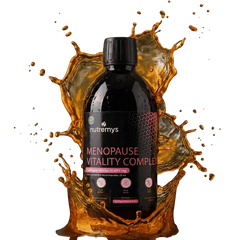
Menopause Vitality Complex supports hormonal balance, metabolism, and comfort during the menopausal transition—with phytoestrogens, marine collagen, and B vitamins in a bioavailable liquid formula.
View Menopause Vitality Complex →The information shared on this blog is for educational and informational purposes only. It does not replace medical consultation, diagnosis or treatment prescribed by a healthcare professional. If you have symptoms, are undergoing treatment or are pregnant, consult your doctor before modifying your diet or starting supplementation. Nutremys LAB food supplements should not replace a varied, balanced diet or a healthy lifestyle.
