



Menopause is medically defined as 12 consecutive months without menstruation. Beyond this threshold, any vaginal bleeding—even minimal or occurring only once—is classified as postmenopausal bleeding (PMB) and requires a gynecological consultation without delay. In approximately 10% of cases, a serious condition is identified. In 90% of cases, the cause is benign. But you cannot know which it is without a clinical evaluation.
What postmenopausal bleeding really is—and why it is never "harmless"
In my clinical practice, I regularly hear the same phrase: "I didn't want to make a big deal of it." A 51-year-old woman waits six weeks before seeking medical advice because she thinks it might be residual hormonal activity, an insignificant peculiarity. I understand where this reluctance comes from. But this is exactly the kind of bleeding that should never wait.
Menopause is officially diagnosed after 12 consecutive months without menstruation. This simple definition has precise implications: once this milestone has been reached, the endometrium—the tissue lining the inside of the uterus—should no longer behave like a cyclical lining. It should no longer bleed. Ever. So if you bleed after three years without menstruation, it is not your body reviving old hormonal habits. It is a signal that warrants investigation.
These figures are not intended to cause alarm. They are intended to provide context. The good news is that most causes are treatable and often not serious. The bad news is that it is impossible to distinguish harmless endometrial atrophy from early endometrial cancer without a clinical examination and appropriate investigations. No doctor can determine this by sight alone. Neither can you.

All possible causes—from the most common to the most serious
What makes this clinically challenging—and what general practice sometimes handles too quickly—is that benign and serious causes often present in almost identical ways. Light, brown bleeding that occurs only once. It could be vaginal atrophy. It could also be endometrial cancer at a very early stage, with an excellent prognosis if detected at precisely that point.
| Cause | Frequency | Level of urgency |
|---|---|---|
| Endometrial or vaginal atrophy | Most common benign cause | Requires evaluation |
| Endometrial or cervical polyps | Very common, often benign | Close monitoring |
| Endometritis (infection of the uterine lining) | Less common | Antibiotic treatment |
| Endometrial hyperplasia | Less common—potentially precancerous | Active management |
| Uterine fibroids (less common after menopause) | Rare but possible | Monitoring |
| Endometrial cancer | ~10% of PMB cases | Urgent |
| Cervical or vaginal cancer | Less common | Urgent |
| HRT, tamoxifen, or anticoagulants | Common if treatment is ongoing | Report to your doctor |
| Urological or anorectal origin (mistaken for PMB) | Underestimated in consultations | Additional testing |
| Trauma or sexual assault | Always investigate sensitively | Immediate evaluation |
A clinical paradox that conventional medicine rarely explains: endometrial atrophy—an endometrium that becomes drastically thinner as estrogen levels fall—is the most common benign cause of PMB. Intuition would suggest that thinner tissue bleeds less. The opposite is true. A severely atrophied endometrium has fragile blood vessels that can cause spontaneous, minor contact bleeding, perfectly mimicking an abnormal signal when it is not. But ruling it out without an examination would be a major clinical error.
According to an analysis published in JAMA Internal Medicine (Clarke et al., 2018), involving more than 2,000 women with postmenopausal bleeding, endometrial atrophy accounts for 50 to 60% of identified causes. Endometrial polyps follow at approximately 15–20%. Endometrial cancer—which is also the most common gynecologic cancer in industrialized countries—is found in 5 to 12% of cases, depending on the cohorts, with its frequency increasing significantly with age and in the presence of certain risk factors: obesity, type 2 diabetes, nulliparity, and a history of polycystic ovary syndrome.
What the gynecologist will try to rule out—and how
The first consultation for postmenopausal bleeding follows a fairly precise protocol. Knowing this protocol beforehand is not about anticipating the answers—it is about understanding why certain tests are requested and not leaving with unanswered questions that you never voiced.

Transvaginal ultrasound: the starting point
The first-line examination is a transvaginal ultrasound. It measures the thickness of the endometrium: the threshold generally used in a postmenopausal woman is 4 to 5 mm. Below this value, the risk of endometrial cancer is very low. Above it, further investigations are necessary. This is not an absolute rule—I have cared for patients with an endometrial thickness of 3 mm and a polyp that was not visible on standard ultrasound—but it is the first clinical reference point.
Endometrial biopsy and hysteroscopy
When an ultrasound reveals a structural abnormality or when bleeding persists without an identified cause, an endometrial biopsy is performed—a tissue sample taken in a doctor’s office or as a day-hospital procedure. Hysteroscopy—visual examination of the uterine cavity through the natural passage—allows the cavity to be visualized and biopsied at the same time. It sounds intimidating on paper, but it is very well tolerated in the vast majority of cases, often without general anesthesia.
What about the Pap smear?
If your last Pap smear was more than three years ago, your gynecologist will probably perform one during the same appointment. Cervical cancer remains rare in women whose previous Pap smears were normal—but menopause does not eliminate the need for screening.
Before your appointment
Note the exact date of the bleeding, its approximate amount, its color (bright red, brown, pink), its duration, and whether you are taking hormone therapy or any other medication. This information immediately helps guide the diagnosis.
Questions to ask your doctor
What is the thickness of my endometrium on the ultrasound? Was a polyp or abnormality seen? Is a biopsy necessary? What is the usual turnaround time for the results?
Risk factors to mention
Obesity, type 2 diabetes, prolonged exposure to estrogen without progesterone (late menopause, early puberty), nulliparity, and a history of PCOS are factors that alter the level of investigation recommended.
Family history to report
Endometrial cancer, colorectal cancer, or Lynch syndrome in the family? Always report it — this can radically change the recommended monitoring protocol.
When hormonal treatment or medication may be involved
If you are taking hormone replacement therapy (HRT), the situation is different — but no less closely monitored. Unexpected bleeding while on HRT may simply indicate a formulation imbalance, irregular absorption, or a need for dose adjustment. It may also indicate something else. The rule remains the same: it must be evaluated.
Tamoxifen — prescribed to prevent recurrence of certain hormone-dependent breast cancers — is a special case. It acts as an anti-estrogen in breast tissue but has a pro-estrogenic effect on the endometrium. Women taking tamoxifen have a significantly increased risk of endometrial polyps, hyperplasia, and cancer. Any vaginal bleeding while taking tamoxifen should be reported immediately to the oncologist and gynecologist, without waiting for the next scheduled appointment.
One point I systematically address in consultations, but few doctors mention spontaneously: anticoagulants — including preventive-dose aspirin and direct oral anticoagulants (DOACs) — can cause or worsen genital bleeding in postmenopausal women, particularly when associated with vaginal atrophy. This is not a contraindication to these treatments — they are often life-saving — but it is information that should be included in the overall assessment.

What conventional medicine still takes too little into account in this context: non-gynecological causes of bleeding. Terminal hematuria during urination, or bleeding of hemorrhoidal or rectal origin—these situations are underestimated during consultations because they require the patient to carefully observe the precise context in which the bleeding occurs. A 48-hour clinical journal can save significant diagnostic time.
What you can do before your gynecological appointment
The absolute priority is to seek medical advice. Not in three weeks. This week. If your primary care physician cannot see you promptly, go to the gynecological emergency department of a maternity hospital or medical center. Postmenopausal bleeding is a legitimate reason for urgent consultation—do not let politeness or fear of “bothering” anyone delay an assessment that could change your prognosis.
Record in a journal:
- the date or dates of the bleeding
- its appearance (bright red, brown, pink)
- its relative amount (a few traces on toilet paper or the need for protection)
- its duration
- any associated pain
- whether sexual intercourse preceded the bleeding within the previous 48 hours
Avoid sexual intercourse until your gynecological assessment—not because it caused the bleeding, but because contact bleeding can distort the clinical interpretation during the examination.
Also prepare a complete list of your medications and dietary supplements—including phytoestrogens, adaptogenic herbal supplements, and any past or current hormone treatments.
This is what I often tell my patients: your body speaks to you in the only language it knows. Bleeding has no ill intent—but it deserves a medical response. The functional and integrative medicine I practice is not an alternative to a gynecological assessment. It comes afterward, as a complement. But it never replaces it.
Once serious causes have been ruled out—and statistically, this is the most likely scenario—it is time to consider overall hormonal balance. The drop in estrogen that accompanies menopause is not an insignificant detail: it affects the endometrium, the vaginal lining, the skin, the bones, sleep, mood, and cognition. This is where targeted micronutrition and phytoestrogens can play a real role—not to treat bleeding, but to support the hormonal transition in all its duration and complexity.
→ Read also: Menopause symptoms explained by a gynecologistFrequently Asked Questions
This article is provided for informational and educational purposes only. It does not replace personalized medical advice or a gynecological consultation. In the event of vaginal bleeding after menopause, consult a gynecologist or physician without delay.
Support your hormonal balance every day
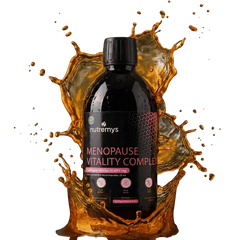
Once your assessment has been completed and serious causes have been ruled out, the question of overall hormonal support remains. Nutremys Menopause Vitality Complex is formulated to support women during perimenopause and menopause with targeted ingredients — red clover, Dong Quai, Maca, and marine collagen — at clinically studied dosages, in a liquid formula with optimal bioavailability. At this stage of life, guesswork is no longer acceptable.
Discover the Menopause Vitality Complex →
Gynecologist practicing in Paris for 18 years, specialized in women's hormonal health, perimenopause and menopause. At Nutremys LAB, she brings her medical perspective to every product we offer.
Learn more about Dr. Mariam E.K. →


The information shared on this blog is for educational and informational purposes only. It does not replace medical consultation, diagnosis or treatment prescribed by a healthcare professional. If you have symptoms, are undergoing treatment or are pregnant, consult your doctor before modifying your diet or starting supplementation. Nutremys LAB food supplements should not replace a varied, balanced diet or a healthy lifestyle.
