

A good menopause supplement is not limited to a single ingredient—it is based on a scientifically designed synergy
Looking for the best menopause supplement? The answer lies not in a brand, but in the formulation. Menopause triggers a cascade of hormonal changes that affect the bones, skin, sleep, mood, and digestion. An effective menopause dietary supplement should target all five areas simultaneously with active ingredients dosed at clinically validated levels—not decorative micro-doses.
In this article, we break down the 6 ingredients recommended by science for better menopause support, the criteria for choosing a good supplement, and the pitfalls to avoid.
Why menopause increases the need for supplementation

The drop in estrogen at menopause is not limited to hot flashes. It triggers a series of metabolic imbalances that affect almost every bodily system:
- Bones lose density.
- Cardiovascular risk increases.
- Skin becomes thinner.
- Sleep deteriorates.
- The gut and vaginal microbiomes become imbalanced.
Understanding these mechanisms is the first step toward identifying the best menopause supplement for your needs.
The 5 key areas a menopause supplement must address
A supplement designed for menopause must act on five fronts simultaneously. A single-ingredient supplement, no matter how good, cannot meet all these needs. Synergy is key.
Preserve bone density in the face of accelerated postmenopausal loss
Support the nervous system and quality of nighttime rest
Protect the cardiovascular system and stabilize mood
Counter the loss of skin collagen and dryness
Restore the balance of the altered gut and vaginal flora
Menopause is not a disease—it is a physiological transition. But it creates specific nutritional needs that diet alone does not always cover, especially in the face of vitamin D deficiency (affecting more than 80% of European women), magnesium deficiency (70% of French women consume less than the recommended amounts), and insufficient calcium intake. A well-formulated supplement fills these gaps in a targeted way.
The 6 ingredients of an effective menopause supplement
To be considered the best menopause supplement, a dietary supplement must combine these six active ingredients at clinically validated dosages. Here's why each one is essential—and which form to choose.
Bones, skin, joints
Calcium absorption, immunity
Sleep, stress, D3 cofactor
Heart, mood, inflammation
When dietary intake is insufficient
Gut & vaginal microbiome
🐟 Hydrolyzed marine collagen — the structural pillar of menopause
Collagen accounts for 30% of the body's proteins. It forms the organic framework of bones, cartilage, and skin. During menopause, endogenous collagen production drops sharply along with estrogen. This accelerates bone loss and skin aging.
Hydrolyzed marine collagen is broken down into bioactive peptides (5 to 10 g/day). In randomized controlled trials, it has demonstrated its ability to improve bone mineral density and skin elasticity in menopausal women. The hydrolyzed form is essential: it offers over 90% bioavailability thanks to a reduced molecular weight that facilitates intestinal absorption.
☀️ Vitamin D3 — correcting vitamin D deficiency during menopause
Without vitamin D3, the body absorbs only 10 to 15% of dietary calcium. That is a dramatically insufficient rate for maintaining bone density. Vitamin D3 (cholecalciferol) is the most effective form, because it is the same form naturally synthesized by the skin under the influence of sunlight. The EFSA recognizes its role in maintaining normal bones, normal muscle function, and reducing the risk of falls in people over 60. In Europe, more than 80% of postmenopausal women have insufficient vitamin D levels. This makes it the most urgent deficiency to correct.
⚙️ Magnesium bisglycinate — the forgotten cofactor
Magnesium is the great forgotten ingredient in menopause formulas—even though it is involved in more than 300 enzymatic reactions. It is essential for converting vitamin D into its active form (calcitriol) and for regulating parathyroid hormone. A study conducted in Granada on 52 postmenopausal women showed that magnesium supplementation (500 mg/day for 8 weeks) significantly improved vitamin D status. Bisglycinate is the best-tolerated and most bioavailable form. It does not cause the digestive problems commonly associated with magnesium oxide.

🐟 Omega-3 EPA/DHA — cardiovascular protection and emotional stability
The drop in estrogen eliminates its cardioprotective effect, significantly increasing cardiovascular risk after menopause. Omega-3s, particularly EPA and DHA, exert a powerful anti-inflammatory effect, support vascular health, and help stabilize mood. Recent systematic reviews have shown that omega-3 supplementation may reduce depressive symptoms associated with menopause. The EFSA recommends a minimum intake of 250 mg of EPA + DHA per day to maintain normal heart function.
🦴 Calcium — supplementing the diet
Calcium remains the bone-building mineral par excellence. But beware: it should only be supplemented if dietary intake is insufficient (less than 800 mg/day). The EFSA authorizes the claim that products providing at least 400 mg of calcium per serving contribute to reducing bone mineral density loss in postmenopausal women aged 50 and over. Calcium citrate is preferable to carbonate for women with low stomach acid. This is a common phenomenon after age 50.
🦠 Targeted Probiotics — Rebalancing the Microbiota
Menopause disrupts the composition of the vaginal and intestinal microbiota. Declining estrogen levels reduce the population of protective lactobacilli. This increases vulnerability to infections and digestive problems. Specific strains such as Lactobacillus rhamnosus, Lactobacillus reuteri, and Bifidobacterium bifidum have demonstrated their ability to restore microbial balance and improve digestive comfort. A quality probiotic should contain clinically documented strains at sufficient concentrations (at least 10 billion CFU).
These six ingredients do not work independently of one another. Magnesium activates vitamin D, which enables calcium absorption. Calcium then binds to the bone collagen matrix. Omega-3s modulate the inflammation that accelerates bone resorption. Probiotics optimize intestinal absorption of all these nutrients. It is this synergy that makes the difference between a supplement that works and mere nutritional marketing.
A formula that combines these 6 active ingredients in synergy
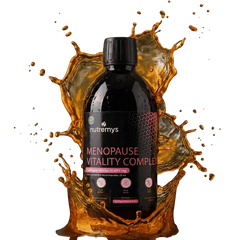
Hydrolyzed marine collagen, vitamin D3, and magnesium — discover our formula designed to support you through menopause with science and gentleness.
Discover Menopause Vitality →Collagen, Vitamin D, and Magnesium for Menopause: What the Studies Say
A good menopause supplement is not based on promises—it is backed by clinical data. Here are the most robust studies supporting the selection of these ingredients.

A randomized, double-blind, controlled trial involving 131 postmenopausal women. Daily intake of 5 g of collagen peptides for 12 months resulted in a statistically significant increase in bone mineral density in the spine and femoral neck compared with the placebo group. A 4-year follow-up study confirmed the durability of these results.
A meta-analysis published in 2025 analyzed all randomized trials evaluating the effects of collagen alone or combined with calcium and vitamin D. Conclusion: the combination of all three active ingredients consistently outperformed calcium + vitamin D alone in terms of improving bone mineral density, confirming the importance of synergy.
Fifty-two healthy postmenopausal women received 500 mg/day of magnesium or a placebo for 8 weeks. The magnesium group showed a significant increase in vitamin D status compared with the control group—even without direct vitamin D supplementation. This confirms magnesium’s role as an essential cofactor.
The European Food Safety Authority officially recognizes that calcium and vitamin D help reduce the loss of bone mineral density in postmenopausal women over 50 (with 400 mg of calcium and 800 IU of vitamin D3 per day). Magnesium has authorized claims for reducing fatigue, supporting normal nervous system function, and maintaining normal bones. These are the only ingredients with health claims officially validated by European authorities in the context of menopause.
Scientific evidence points toward a synergistic approach. The best supplement for menopause is not the one containing the trendiest ingredient, but the one that combines complementary active ingredients at clinical doses. Collagen underdosed at 2 g, vitamin D at 200 IU, or magnesium in the poorly absorbed oxide form will not produce the effects observed in studies. The form and dose matter just as much as the choice of ingredient.
Choosing a menopause supplement without phytoestrogens: the 5 criteria
Not all menopause supplements are created equal. Here are the five essential criteria for distinguishing an effective formula from a purely marketing-driven product. These principles apply regardless of which supplement you choose—including those available in our guide to essential supplements after 50.
Prioritize calcium citrate (rather than carbonate), magnesium bisglycinate (rather than oxide), vitamin D3 (rather than D2), and hydrolyzed marine collagen (rather than non-hydrolyzed or bovine collagen). Bioavailability determines how much is actually absorbed by the body—and can vary threefold depending on the form chosen.
Many supplements display a long list of ingredients but at dosages too low to produce a real effect. Check that the amounts correspond to the dosages used in clinical studies: at least 5 g of collagen, 1,000 IU of vitamin D3, and 300 mg of elemental magnesium. One properly dosed ingredient is better than ten underdosed ingredients.
Phytoestrogens (soy isoflavones, red clover) are contraindicated for women with a history of hormone-dependent cancers. A good universal menopause supplement should be formulated without these compounds to suit as many people as possible. Women wishing to include phytoestrogens should do so under medical supervision and separately.
Demand complete labeling with the exact amount of each active ingredient, the origin of the ingredients, and quality certifications. Beware of “proprietary blends” that conceal individual dosages behind an overall mixture. Transparency is the first sign of a laboratory’s seriousness.
The best supplement for menopause is not the one containing the most ingredients, but the one whose active ingredients work together coherently. Magnesium activates vitamin D, vitamin D enables calcium absorption, and calcium binds to the collagen matrix. This synergy should be evident in the product’s design. A supplement combining collagen + vitamin D + magnesium + calcium in carefully studied proportions will always be more effective than a collection of single-ingredient capsules taken separately.
What a good menopause supplement should NOT contain
Conversely, some ingredients frequently included in menopause supplements lack solid evidence of effectiveness—or carry risks you should know about.
Often promoted for hot flashes, high-dose vitamin E alone has shown only a minimal effect in studies. Worse, excessive intake has been associated with increased mortality in some meta-analyses. Dietary intake (vegetable oils, nuts and seeds) remains more than sufficient.
DHEA is a precursor hormone to estrogen. Its use as a supplement requires medical hormone monitoring and should never be present in an over-the-counter dietary supplement. European health authorities are strict on this matter.
Although wild yam is used as a basis for manufacturing synthetic hormones in the laboratory, the human body does not have the enzymes necessary to carry out this conversion. Wild yam supplements have never demonstrated effectiveness in clinical trials on menopause symptoms.
Soy isoflavones and red clover are phytoestrogens that act on estrogen receptors. Since 2012, the EFSA has prohibited supplements containing isoflavones from claiming relief from hot flashes or maintenance of bone density, due to insufficient evidence. In addition, these compounds are contraindicated in cases of a history of hormone-dependent cancers (breast, uterine, or ovarian). They should only be considered following individualized medical advice.
FAQ — Frequently asked questions about the best menopause supplement
Discover our formula designed to support menopause with science and gentleness
Hydrolyzed marine collagen, vitamin D3, magnesium… a synergy of active ingredients formulated to support your vitality, comfort, and bone health during menopause.
Explore the Menopause Vitality formula →doi.org/10.3390/nu10010097
pubmed.ncbi.nlm.nih.gov/34520654
pubmed.ncbi.nlm.nih.gov/41049371
pmc.ncbi.nlm.nih.gov/PMC7468838
efsa.europa.eu
anses.fr



The information shared on this blog is for educational and informational purposes only. It does not replace medical consultation, diagnosis or treatment prescribed by a healthcare professional. If you have symptoms, are undergoing treatment or are pregnant, consult your doctor before modifying your diet or starting supplementation. Nutremys LAB food supplements should not replace a varied, balanced diet or a healthy lifestyle.
