





At a glance
- After age 45: no blood test is necessary if symptoms are typical and periods have been absent for 12 months.
- Before age 45: FSH testing (repeated 4–6 weeks apart) becomes relevant.
- The four useful markers: FSH, estradiol (E2), AMH, and TSH — each answers a different question.
- Pitfall no. 1: during perimenopause, hormone levels fluctuate from one week to the next. A single result proves nothing.
- Pitfall no. 2: the contraceptive pill or a hormonal IUD can distort FSH interpretation.
- Don't forget: the thyroid can mimic almost all menopause symptoms. TSH testing is worth considering.
What is a menopause blood test really used for?
This is the most common request in consultations: “Doctor, I would like a blood test to find out whether I am menopausal.” The answer often comes as a surprise. In most cases, it tells you nothing your body has not already told you.
Menopause is defined retrospectively: twelve consecutive months without periods, in the absence of another cause. It is not a level; it is a date. The British recommendations from NICE (guideline NG23), widely followed in Europe, are explicit: in women over 45 with typical symptoms, the diagnosis is made without any hormone testing.

The three situations in which a blood test becomes useful
There are nevertheless situations in which laboratory testing genuinely helps inform the decision:
You are under 45
Between ages 40 and 45, irregular cycles accompanied by suggestive symptoms warrant an FSH test. Before age 40, it becomes essential: the aim is to look for premature ovarian insufficiency, which affects approximately 1% of women according to the recommendations of the ESHRE.
The clinical picture is atypical
Severe fatigue, rapid weight gain, hair loss, sensitivity to cold: these signs resemble menopause but may be caused by the thyroid, anemia, or a deficiency. Blood tests are then used to rule things out, not to confirm menopause.
You no longer have a menstrual reference point
After a hysterectomy, or while using a hormonal IUD, the absence of periods no longer means anything. Testing becomes one of the few objective clues available.
Treatment is being considered
Before starting hormone therapy, your doctor may want a quantified baseline. This is a medical decision, never something to undertake on your own.
What a blood test cannot do: it cannot predict the date of your last period, measure the future intensity of your symptoms, or tell you how long the transition will last. It captures a moment, not a trajectory.
Which tests to request: FSH, estradiol, AMH, and TSH
When a menopause blood test is warranted, four markers provide most of the essential information. Each answers a different question—and none can be interpreted in isolation.
FSH — follicle-stimulating hormone
Secreted by the pituitary gland to stimulate the ovaries. When the ovarian reserve is depleted, the pituitary “shouts louder”: FSH rises. It is the most widely used marker, and the most frequently misinterpreted.
Estradiol (E2)
The main estrogen produced by the ovaries. It decreases as ovarian activity declines—but during perimenopause, it can also surge sharply before falling.
AMH — anti-Müllerian hormone
Reflects the remaining ovarian reserve. Stable throughout the cycle, it is mainly used in fertility medicine. It does not date menopause; it indicates its direction.
TSH — thyroid-stimulating hormone
The overlooked marker. Hypothyroidism reproduces almost all the symptoms of menopause: fatigue, weight gain, mood swings, and fragile hair. It is common after age 50 and responds well to treatment.
Common additional tests
Ferritin, vitamin D, fasting blood glucose, and a lipid panel are often added. They do not diagnose menopause but explain much of the fatigue wrongly attributed to hormones.
What is not routinely useful
Testing LH, progesterone, or testosterone adds nothing to the diagnosis of menopause for most women. A “complete” hormone panel is not a more reliable panel.
When should you have the blood test? If you still have periods, the sample is classically taken between the 2e and 4e day of the cycle. Fasting is not necessary for hormone tests, but it is if your doctor adds a blood glucose or lipid panel. If in doubt, call the laboratory the day before.
How to read your results without making a mistake
You have the report in front of you. Two columns, unfamiliar units, arrows. Here is the reading framework I use in consultations—always to be compared with your laboratory’s reference values, which vary depending on the technique used.
| Profile | FSH | Estradiol | Most likely interpretation |
|---|---|---|---|
| Ovarian activity preserved | Low to normal | Normal | You are not menopausal. The symptoms may have another cause. |
| Transition (perimenopause) | Variable, sometimes high | Fluctuating, sometimes very high | The most common—and most misleading—profile. A single test is not conclusive. |
| Established menopause | High and stable | Low | Consistent with menopause, to be confirmed clinically (12 months without periods). |
| While using hormonal contraception | Artificially suppressed | Uninterpretable | The result does not mean anything on its own. The approach needs to be adapted with your doctor. |
The three most common interpretation errors
During perimenopause, FSH can go from “normal” to “menopausal” in three weeks. That is why ESHRE recommends two tests taken 4 to 6 weeks apart before drawing any conclusions.
A “high” FSH level is compared with a population of women of reproductive age. At 52, a high FSH level is physiological, not pathological.
The pill, hormonal IUD, acute stress, and recent illness can all alter hormone levels. A number without context is a meaningless number.

The figure to remember. In France, the average age at menopause is around 51, according to the INSERM, with a very broad normal range—from 45 to 55. The perimenopause that precedes it can last several years. In other words, your personal timeline is more meaningful than a single test result. To identify your stage, our article on the differences between perimenopause and menopause provides practical guidance.
Home tests and age calculators: how useful are the alternatives?
Menopause urine tests sold in pharmacies detect FSH in urine. The principle is sound, but the limitation is the same as with blood tests: they measure a single moment during a period when everything fluctuates. A test can be positive one day and negative ten days later. They may provide reassurance, but they do not replace medical advice.
As for online menopause age calculators, they are based on statistical averages and your mother's age at menopause—a real factor, but far from decisive. Smoking, certain treatments, and a history of surgery also influence the result.
The most useful information is still what you record yourself: a cycle diary. Note the dates of your periods, the intensity of hot flashes, the quality of your sleep, and your energy levels. Three months of notes are often more valuable than a single test—and your doctor will gain much more information from them. If sleep is your weak point, our guidance on insomnia during menopause is a useful complement to this tracking.
A sign that requires a medical consultation, regardless of the blood test result: any bleeding occurring after twelve months without periods must be medically investigated without delay. This is not a return of menopause; it is a reason for examination.
Signs that you may benefit from supplementation
A blood test gives you an indication. It does not relieve your symptoms. Once the diagnostic question has been settled, the real question becomes: how can you support your body during this transition?
Certain signs deserve attention, regardless of your hormone levels:
- Fatigue that does not improve with rest, present upon waking as well as at the end of the day.
- Skin that becomes dehydrated, splitting nails, and thinner hair—the synthesis of collagen slows as estrogen levels decline.
- Stiff joints in the morning, particularly in the hands and knees.
- Fragmented sleep, often interrupted between 3 a.m. and 5 a.m.
- A diet that, on honest analysis, does not provide enough magnesium, vitamin D, and protein.
These symptoms call for nutritional support, not a laboratory diagnosis. Magnesium, vitamin D, B vitamins, and collagen are among the nutrients whose requirements increase during this period. To understand what distinguishes a serious formula from a marketing-driven mix, our comparison of liquid or capsule menopause supplements details the bioavailability criteria. And if phytoestrogens intrigue you, our guide to isoflavones reviews what science really allows us to say about them.

This article is for informational purposes only and does not replace medical advice. Any interpretation of laboratory results should be discussed with your doctor or gynecologist.
Your results are clear. What now?
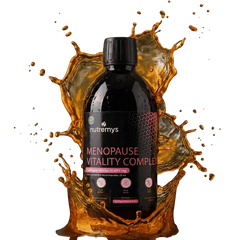
Menopause Vitality Complex combines marine collagen, magnesium, vitamin D, and a B-complex in a liquid formula designed to support your body during the transition—without hormones.
Discover Menopause Vitality ComplexFrequently asked questions
What blood test should you request to find out whether you are menopausal?
The standard test measures FSH and estradiol (E2). Depending on the context, your doctor may also order TSH to rule out a thyroid cause, and AMH to assess ovarian reserve. A “complete hormone panel” including LH, progesterone, and testosterone generally adds nothing to the diagnosis.
After age 45, with typical symptoms and twelve months without periods, no blood test is necessary: the diagnosis is clinical.
How should you interpret a menopause blood test?
The suggestive profile of established menopause combines high, stable FSH with low estradiol. But this result is never interpreted on its own: it must be consistent with your age, the absence of periods for twelve months, and your symptoms.
Beware of the laboratory arrows: reference values are calibrated for women of childbearing age. A “high” FSH level at age 52 is simply normal for your stage of life.
Do you need to fast for a menopause blood test?
No, hormone tests (FSH, estradiol, AMH, TSH) do not require fasting. Fasting is necessary only if your prescription includes a blood glucose or lipid panel, which is common in a comprehensive check-up after age 50.
If you still have cycles, schedule the blood draw between the 2th and the 4th day of your period.
Does the pill distort the results?
Yes, significantly so. Hormonal contraception suppresses FSH secretion, making the result uninterpretable. The same applies, to varying degrees, to some hormonal IUDs.
Only your doctor can decide whether a temporary pause is appropriate before testing—this decision should never be made on your own, particularly because pregnancy remains possible during perimenopause.
Is a menopause test bought at a pharmacy reliable?
These tests detect urinary FSH. The principle is valid, but they share the major limitation of blood tests: during perimenopause, FSH fluctuates considerably from one week to the next. An isolated positive result confirms nothing, and a negative result rules nothing out.
They can serve as a first point of reference, but never as a conclusion.
Scientific sources
- NICE — Menopause: diagnosis and management (NG23)
- INSERM — Menopause information
- ESHRE — Guidelines (premature ovarian insufficiency)
- Health Insurance — Menopause: symptoms and diagnosis
- French National Authority for Health — Good practice guidelines
- CNGOF — French National College of Gynecologists and Obstetricians
- EFSA — Health claims
The information shared on this blog is for educational and informational purposes only. It does not replace medical consultation, diagnosis or treatment prescribed by a healthcare professional. If you have symptoms, are undergoing treatment or are pregnant, consult your doctor before modifying your diet or starting supplementation. Nutremys LAB food supplements should not replace a varied, balanced diet or a healthy lifestyle.
