

The essentials before choosing
- Collagen makes up around 30% of your body's proteins; its synthesis decreases by around 1% per year from age 25–30, then drops sharply at menopause.
- Of the nearly 28 types identified, only five are commonly used: I, II, III, V, and X. Type I accounts for ~90% of the body's collagen.
- The source (marine, bovine, porcine, chicken) determines the type of collagen; the form (hydrolyzed, peptides) determines absorption.
- Marine collagen is closest to human skin collagen (type I) and is the best absorbed.
- An often-overlooked decisive criterion: the actual dose per serving and label transparency.
Collagen: the body's framework, and why it weakens

Collagen is the most abundant protein in the body: it makes up around 30% of our total proteins and forms the framework of the skin, bones, tendons, cartilage, blood vessels, and mucous membranes. It is what gives skin its firmness and tissues their elasticity.
But its natural production declines. From age 25 to 30, we lose approximately 1% of collagen per year. During menopause, the drop in estrogen — which stimulates fibroblasts, the cells that produce collagen — sharply accelerates the process: a significant proportion of skin collagen may be lost in the first few years following menopause. This is why collagen becomes a central concern after age 40. To understand this hormonal mechanism in detail, see our complete guide to marine collagen & menopause.
Taking supplements can support the body — but you still need to choose the right collagen. To do so, you need to distinguish between two concepts that marketing often conflates: the type of collagen and its animal source.
Collagen types: I, II, III… what each one does
Nearly 28 types of collagen have been identified, but five are enough to cover most needs. Knowing the type means knowing which tissue it works in.
The most abundant (~90% of the body). This is the collagen responsible for skin firmness, hair, nails, bones, and mucous membranes. The No. 1 choice for skin beauty and intimate comfort during menopause.
A major component of articular cartilage. This is the type sought for joint comfort, often in the form of undenatured collagen (UC-II) at a very low dose.
Works alongside type I in the skin, organs, and blood vessel walls. It contributes to the elasticity and structure of young tissues.
Present in smaller amounts, they contribute to fiber formation (V) and bone and cartilage mineralization (X). Rarely targeted on their own.
Looking for an effect on skin, hair, and mucous membranes? Choose type I. Looking for joint comfort? Type II is more suitable. Many “skin” formulas contain types I & III — which makes sense, since they coexist in the dermis.
Marine, bovine, porcine, poultry, “plant-based”: the sources compared
The animal source determines which types of collagen you obtain—and how closely they resemble your own. This is where the real choice lies.

A review published in Molecules (León-López et al., 2019) highlights that hydrolyzed collagen is efficiently absorbed as dipeptides and tripeptides, and that marine collagen has among the lowest molecular weights—a key factor in bioavailability. This is one of the reasons it is favored in skin-focused formulas.
In short: “marine or bovine?” has no single answer. For a skin / mucous membranes / hair goal after age 40, marine collagen has the advantage. For a tight budget and versatile use, bovine collagen remains relevant. To learn more about this choice in relation to menopause, see our detailed comparison of which collagen to choose for menopause.
Hydrolyzed collagen, peptides, molecular weight: what determines absorption

A native collagen molecule is too large to pass through the intestinal barrier. That is why supplements use hydrolyzed collagen: the protein is “pre-cut” into short peptides (often 2,000 to 5,000 daltons), which can be absorbed and circulate to the tissues.
Two quality indicators to look for: the mention “hydrolyzed” / “collagen peptides”, and a low molecular weight (the smaller the peptides, the better they are absorbed). Marine collagen naturally meets these criteria. Without hydrolysis, the value of a supplement drops significantly.
Collagen is not used on its own. Vitamin C contributes to normal collagen formation for the skin, cartilage, and bones (an authorized EFSA claim). A good formula therefore combines collagen peptides and cofactors: vitamin C, zinc, and sometimes hyaluronic acid and silica.
How to choose the best collagen: 6 objective criteria

Skin, hair, mucous membranes → type I (marine is ideal). Joints → type II.
Skin studies often use 2.5 to 10 g of peptides per day. Beware of “showcase” doses that are too low.
Look for the mention “hydrolyzed” and, if possible, a low molecular weight. This is essential for absorption.
For marine collagen, choose certified sustainable fishing (ASC/MSC) and a clear origin.
No added sugars, colorants, or unnecessary excipients. The shorter and clearer the list, the better.
Liquid, powder, or capsules: the question of format deserves particular attention (see below).
Liquid, powder, or capsules?
The format does not change the nature of the collagen, but it does change the actual dose you can take and how easy the routine is. To reach 10 g, you would need to swallow 10 to 12 capsules—unrealistic on a daily basis. Powder allows for high doses but requires preparation. Liquid concentrates a high dose into a single serving, with rapid absorption. We explain the dosages in our comparison of drinkable collagen.
Collagen and menopause: why the choice is becoming strategic
After menopause, declining estrogen simultaneously weakens the skin, mucous membranes (including the urogenital membranes), joints, and bones. Type I, hydrolyzed, properly dosed marine collagen combined with its cofactors then becomes particularly relevant nutritional support — without being a treatment. For key figures and sourced data on menopause in France, see our menopause statistics dossier.
Signs that you may benefit from supplementation
- Skin that is becoming looser and drier, with more pronounced fine lines since your forties
- Thinner hair, brittle nails
- Joint discomfort upon waking or during exercise
- Dryness of the mucous membranes (intimate and skin-related) linked to hormonal decline
- Slower recovery after exercise
If several of these signs resonate with you, comprehensive nutritional support — marine collagen plus vitamins and mineral cofactors — makes sense, alongside a protein-rich diet.
Marine collagen designed for mature skin
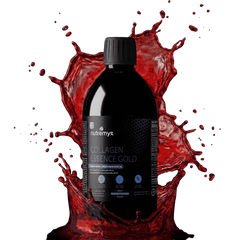
Nutremys's Collagen Essence Gold combines high-dose hydrolyzed marine collagen with hyaluronic acid and vitamin C in a highly bioavailable liquid format — without phytoestrogens.
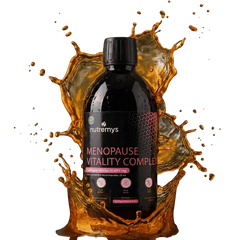
Discover Collagen Essence GoldAre you going through perimenopause or menopause and looking for a comprehensive approach? Menopause Vitality Complex (10,000 mg of marine collagen + 29 other active ingredients) is part of our menopause supplement range.
Frequently asked questions
What is the best marine collagen? ▾
Marine or bovine collagen: which should you choose? ▾
What is the difference between type 1, 2, and 3 collagen? ▾
How much collagen should you take per day? ▾
Does plant-based collagen really exist? ▾
This article is provided for informational purposes and does not replace personalized medical advice. Food supplements are not a substitute for a varied, balanced diet or a healthy lifestyle. If you are undergoing treatment, pregnant, or breastfeeding, ask your doctor for advice.
The information shared on this blog is for educational and informational purposes only. It does not replace medical consultation, diagnosis or treatment prescribed by a healthcare professional. If you have symptoms, are undergoing treatment or are pregnant, consult your doctor before modifying your diet or starting supplementation. Nutremys LAB food supplements should not replace a varied, balanced diet or a healthy lifestyle.
