




At a glance
- Couplepause is a concept proposed in 2018: thinking of the couple's hormonal transition as a whole, rather than as one person's disorder.
- For women: menopause and its drop in estrogen. For men: andropause and a gradual decrease in testosterone.
- Both experience symptoms: fatigue, sleep problems, irritability, and decreased desire.
- The first step isn't medical: it's to talk, honestly and kindly.
- A healthy lifestyle together, and medical advice if quality of life or the relationship suffers.
What is couplepause?
You may have noticed that tensions have increased lately, without any real reason. Restless nights, being unusually sensitive, less frequent desire - on both sides. What if it wasn't “him” or “her,” but both of you, at the same time?
This is precisely the meaning of “couplepause”, a term proposed in 2018 by two Italian professors, one specializing in endocrinology and sexual medicine, the other in gynecology (Jannini and Nappi). The idea: hormonal changes in the forties and fifties almost always occur within a couple and should therefore be considered as a whole. A review published in 2024 puts it this way: the needs of the aging couple should be considered “as a unit,” taking into account physical, psychological, and relational dimensions.
This shift in perspective is valuable. It avoids designating a “culprit” and turns a source of conflict into a question to solve together. It is also an invitation to pause, in the literal sense: to take the time to understand what each person is going through, physically and emotionally, at this crossroads in life.
Menopause and andropause: two different transitions
The two are not alike, and it is important to know that. Menopause is a distinct transition: menstrual cycles stop, estrogen production drops, often fairly quickly, at around age 51 on average. Andropause, on the other hand, is much more gradual: testosterone declines slowly, by around 1 to 2% per year after age 30-40, so the changes sometimes go unnoticed or are attributed to stress, fatigue, or lifestyle.
| Menopause (her) | Andropause (him) | |
|---|---|---|
| Hormone involved | Drop in estrogen | Gradual decline in testosterone |
| Pace | Fairly rapid, over a few years | Very gradual, over decades |
| Marker | Cessation of periods (12 months) | No clear marker |
| Common symptoms | Hot flashes, disrupted sleep, mood changes, reduced desire, dryness | Fatigue, reduced energy and motivation, mood changes, reduced desire, sleep |
We can see it: beyond the differences, the two transitions share common ground - fatigue, sleep disturbances, irritability, and reduced desire. It is precisely this overlap that makes this period difficult to navigate as a couple. To learn more about the female experience, see our guide to menopause symptoms and advice from gynecologists.
The impact on the couple
When two tired, somewhat irritable people who sometimes feel uncomfortable in their changing bodies live under the same roof, misunderstandings arise quickly. An innocent remark becomes a spark. A decline in desire on one side is interpreted as rejection by the other. And often, neither person connects it to hormones.
Physical changes (abdominal weight gain and changes in body shape on both sides), mood swings, and fluctuations in desire can all occur at the same time. The result: communication becomes strained, intimacy becomes less frequent, and distance may develop - not because of a lack of love, but because of a lack of mutual understanding. Menopause brain fog does not help with finding the right words either; we discuss it in our article on perimenopause brain fog.
Moving through the transition, gently
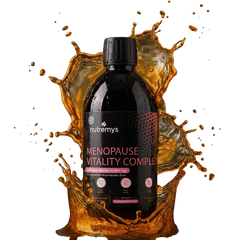
Menopause Vitality Complex supports comfort during the female hormonal transition in a liquid form that is easy to incorporate into everyday life.
Discover Menopause Vitality ComplexGoing through the couplepause together
The good news is that the first lever costs nothing and requires no prescription: it is to talk to each other. From there, a few simple principles can help make this period a shared adventure rather than a solitary ordeal.
1. Talk, really
Talk about what you are feeling, your discomfort, and your concerns. Sharing your symptoms creates understanding and empathy, whereas silence fuels misunderstandings.
2. Show empathy
Not easy when you're running on empty yourself. But validating the other person's experience - «I can see this is hard for you» - soothes and brings you closer.
3. Learn together
Understanding menopause and andropause dispels false interpretations («they no longer desire me»). Reading an article together opens the dialogue.
4. Taking care of yourselves… together
Regular physical activity, a Mediterranean diet, protected sleep, stress management: these measures support hormonal balance in both partners and are easier to maintain together.
When it comes to desire and intimacy, patience and tenderness matter more than performance. Rediscovering your connection, making time for each other without pressure, and breaking down taboos often do more than any «solution». Our article on sexuality during menopause offers practical suggestions. And because the daily burden also weighs on a relationship, see our guide to mental load during menopause.
When to seek advice
Adapting your lifestyle and communicating better is often enough. But if symptoms are seriously affecting quality of life or the relationship, don't hesitate to seek help.
Support for the couple
Couples therapy or relationship counseling can help restore calm communication when tensions arise.
Medical advice, for both partners
For women, MHT (menopausal hormone therapy) is assessed on a case-by-case basis; for men, testosterone testing can be discussed with a doctor.
Persistent symptoms
Fatigue, sadness or loss of desire that has persisted for several weeks should be assessed by a healthcare professional.
The right person to talk to
General practitioner, gynecologist, urologist, sexologist or psychologist: there are several points of entry for both partners.
Your frequently asked questions
What exactly is couplepause?
It refers to both partners in a relationship going through a hormonal transition at the same time: menopause for the woman and andropause for the man, often between the ages of 45 and 60. The concept, proposed in 2018, invites us to view this period as a relationship issue rather than one partner's disorder. The goal: greater understanding and less “blame.”
Does andropause really exist?
The term “andropause” (or “male menopause”) is debated because it does not involve an abrupt cessation like menopause. However, the gradual age-related decline in testosterone is real and well documented. In some men, it can be accompanied by fatigue, low energy and reduced desire, sleep disturbances, or mood changes. A doctor can assess the situation if needed.
At what age does andropause occur?
Testosterone begins to decline gradually from age 30-40, by around 1 to 2% per year. When effects appear, they most often start in the fifties - precisely the period when a partner is often going through perimenopause or menopause. Hence the overlap at the heart of couplepause.
Is declining desire during menopause a relationship problem?
It can become one if it is not understood. A drop in libido has hormonal causes (falling estrogen levels, dryness) but also contextual ones: fatigue, sleep, stress, and self-image. Often, both partners see their desire fluctuate at the same time. Talking about it openly, without assigning blame, and redefining intimacy at your own pace helps far more than pretending nothing is happening.
How should I broach the subject with my partner?
Choose a calm moment, free from tension. Talk about yourself first (“I feel tired, my body is changing”), without blame. You can also read an article together to put words to what you are experiencing. The idea is not to “fix” the other person, but to understand that you are each going through a transition - and that you can go through it side by side.
Scientific sources
The information shared on this blog is for educational and informational purposes only. It does not replace medical consultation, diagnosis or treatment prescribed by a healthcare professional. If you have symptoms, are undergoing treatment or are pregnant, consult your doctor before modifying your diet or starting supplementation. Nutremys LAB food supplements should not replace a varied, balanced diet or a healthy lifestyle.

