


What You’ll Learn in This Article
The food industry invests considerable sums in front-of-pack communication. Claims on the front of the package — “source of fiber,” “high in protein,” “light” — have very precise legal definitions that often have little to do with the product’s actual nutritional quality. Everything happens on the back of the package, in the ingredients list and the nutrition facts table.
In this article, you’ll learn to identify the 12 hidden names of sugar, use the NOVA classification to distinguish real foods from industrial products, understand why the “organic” label is not a blank check — and apply a three-question reading method that takes less than twenty seconds in the supermarket aisle.
The Anatomy of a Label: The 4-Step Method
Before looking at the Nutri-Score or the claims on the front, turn the package over. Everything that matters is on the back, in two distinct areas: the ingredients list and the nutrition facts table. These two sections are regulated and contain information that front-of-pack marketing cannot hide — provided you know how to read them.

The 12 Hidden Names of Sugar
The ingredients list runs from the most abundant to the least abundant. If sugar appears among the first three, the product is primarily sweetened — regardless of the “no added sugar” claim on the front. “No added sugar” only means that no conventional white sugar was added on top of the sugars naturally present in the ingredients. It says nothing about the product’s actual sugar content.
Glucose-fructose syrup deserves particular attention: its glycemic index is very high, and it is metabolized differently from conventional sucrose, with a more pronounced impact on the liver and insulin resistance. Maltodextrin, often presented as a “starch,” has a higher glycemic index than white sugar—it is sugar in every functional respect, without the name that would make it easy to identify.
The 4-step method—60 seconds flat
Count the ingredients
More than five ingredients is an initial warning sign. More than ten is a reason to read carefully. The length of the list is not an absolute rule, but it correlates with the degree of industrial processing.
Look for sugar among the first three ingredients
If it appears there—under one of its twelve names—the product is primarily sugary, regardless of what the front-of-pack label says. The list is ordered by weight in descending order: what comes first is present in the greatest amount.
Look for “E” numbers
Not all of them are problematic—E300 is vitamin C, and E306 is a natural tocopherol. But E621 (monosodium glutamate), E951 (aspartame), E407 (carrageenans), or E471–E472 (mono- and diglycerides of fatty acids) are documented warning signs, particularly in the context of hormonal or intestinal vulnerability.
Read the nutrition facts panel “per 100 g,” never “per serving”
Serving sizes indicated by manufacturers are often undersized compared with actual consumption. Only the “per 100 g” basis allows products to be compared objectively and without bias.
In the nutrition facts panel, the line “of which saturated fats” should account for less than one-third of total fat. A “of which trans fats” line above zero is an absolute red flag: even very small amounts of trans fats increase cardiovascular risk, disrupt estrogen signaling, and promote systemic inflammation—a mechanism of particular concern during menopause.
Identify ultra-processed foods — the NOVA classification
The NOVA classification, developed by researchers at the University of São Paulo, does not assess the nutritional quality of a food—it measures its degree of industrial processing. This distinction is fundamental because a product may be low in calories, high in protein, and still contain additives that disrupt the gut microbiome, the hormonal axis, and satiety signaling.

A simple and effective rule of thumb: if you see an ingredient that you would not be able to buy as-is at a market or grocery store—starch acetate, polydextrose, modified sunflower lecithin, microcrystalline cellulose—it is an industrial ingredient characteristic of NOVA 4 products. This is not an absolute rule, but it is a quick filter to direct your attention toward a more careful reading.
The “organic” label trap: what certification does not guarantee
The organic label certifies the absence of synthetic pesticides in agricultural production. This is relevant and verifiable information. What it does not say—and what many people overlook—is just as important.
Agriculture without synthetic pesticides. No GMOs in ingredients of agricultural origin. Livestock raised with outdoor access. A limited list of permitted additives (about 50 compared with 350 in conventional production). No artificial synthetic flavors.
A low sugar content. The absence of industrial processing. A high Nutri-Score. The absence of packaging at risk of chemical migration. Local sourcing or consistent control standards across countries.
An organic biscuit can contain 30 g of sugar per 100 g in the form of “whole cane sugar” or “apple juice concentrate.” The glycemic impact is identical to that of white sugar. An organic boxed soup with twelve ingredients is a NOVA 3 or 4 product—organic, certainly, but no less processed for it. The Nutri-Score of many organic products is C or D: the organic label says nothing about nutritional density.
1. Fewer than five recognizable and pronounceable ingredients. 2. Sugar does not appear among the first three ingredients in any of its forms. 3. No three-digit E codes among the first ten ingredients, except E300 (vitamin C) and E306 (tocopherols). 4. Saturated fats account for less than one-third of total fat—zero trans fat. 5. At least 2 g of fiber per 100 g, which excludes nearly all ultra-processed foods. These five criteria do not replace a complete label review, but they make it possible to sort products in thirty seconds in the supermarket aisle.
Why ultra-processed foods worsen menopausal symptoms
The question is not insignificant. During menopause, several biological mechanisms that are already weakened are directly disrupted by regular consumption of ultra-processed foods—and understanding these mechanisms changes how we approach our daily food choices.
Emulsifiers (E471, E472, carrageenans) disrupt the composition and permeability of the gut microbiome. This is significant because it is in the gut that dietary phytoestrogens—isoflavones from soy and lignans from flax—are converted into active molecules by specialized bacteria. An altered microbiome directly reduces the bioavailability of phytoestrogens, diminishing their effect on hot flashes and menopausal discomfort.
High-glycemic-index sugars amplify the insulin resistance already intensified by the drop in estrogen—promoting abdominal fat storage, unstable blood sugar, and the characteristic afternoon cravings that many women describe during menopause.
Trans fats and refined oils increase low-grade systemic inflammation. Inflammation is one of the factors that amplify the frequency and intensity of vasomotor symptoms—hot flashes and night sweats—according to several epidemiological studies published in Menopause and the Journal of the North American Menopause Society.
Finally, some additives classified as potential endocrine disruptors—BHA (E320), BHT (E321), and certain azo dyes—may interfere with estrogen receptors, worsening an already existing hormonal instability. These findings remain partly preliminary for some additives, but the precautionary principle applies all the more because menopause is already a period of endocrine vulnerability.
Reducing ultra-processed foods is one of the most accessible and least costly ways to improve menopausal comfort. Not because they are a direct cause of menopause symptoms, but because they amplify several of the biological mechanisms that influence their intensity. This is a fundamental nutritional intervention, not a shortcut.
Frequently asked questions
A formula with no compromise on ingredients
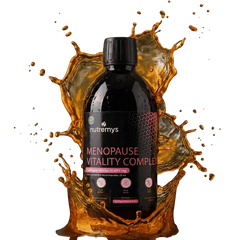
Menopause Vitality Complex Nutremys — transparent ingredient list, zero unnecessary additives, 10,000 mg of marine collagen, and certified phytoestrogenic active ingredients. Because reading a label should always lead to a pleasant surprise.
View the full composition →The information shared on this blog is for educational and informational purposes only. It does not replace medical consultation, diagnosis or treatment prescribed by a healthcare professional. If you have symptoms, are undergoing treatment or are pregnant, consult your doctor before modifying your diet or starting supplementation. Nutremys LAB food supplements should not replace a varied, balanced diet or a healthy lifestyle.
