




La ménopause est un point précis : douze mois consécutifs sans menstruation. La périménopause est la zone de transition qui la précède — souvent quatre à dix ans pendant lesquels les hormones fluctuent de manière irrégulière. C'est paradoxalement cette phase de transition qui s'accompagne du plus grand nombre de symptômes, parce que les variations brutales d'œstradiol perturbent davantage le corps qu'une baisse stable et installée. Comprendre dans quelle étape vous êtes ne change pas l'âge biologique — mais cela transforme la stratégie de soutien la plus efficace pour votre corps maintenant.
Les deux étapes en clair — définitions médicales précises
La confusion entre périménopause et ménopause est l'une des principales sources d'errance diagnostique chez les femmes entre 40 et 55 ans. Cette confusion n'est pas anodine : elle conduit souvent à attendre passivement une « ménopause » dont on n'est en réalité qu'au début de la longue préparation. Définir précisément les termes est la première étape pour reprendre la main.
La ménopause, un point précis
La ménopause, médicalement, n'est pas une période. C'est un point précis dans le temps : le jour où l'on constate que les règles se sont arrêtées depuis exactement douze mois consécutifs. Avant cette date, on ne peut pas affirmer qu'une femme est ménopausée — il pourrait y avoir un nouveau cycle. Après cette date, le diagnostic est rétrospectif et définitif. En France, l'âge médian de la ménopause est de 51 ans, avec un écart-type large : la grande majorité des femmes la traversent entre 45 et 55 ans.
La périménopause, une zone de transition de 4 à 10 ans
La périménopause, elle, est une période — souvent longue. Elle débute quand les cycles commencent à devenir irréguliers et se termine douze mois après les dernières règles. Sa durée moyenne est de quatre ans, mais elle peut s'étendre jusqu'à dix ans chez certaines femmes. Pour beaucoup, elle commence vers 45 ans, parfois bien plus tôt — dès 38 ou 40 ans dans les cas de ménopause précoce ou de prédisposition génétique. Concrètement, cela signifie qu'une femme de 47 ans qui présente des symptômes hormonaux n'est presque jamais « ménopausée » : elle est en périménopause, et c'est cette distinction qui doit guider les choix de prise en charge.
Pourquoi cette distinction change tout pour vos décisions de santé
La périménopause et la ménopause établie ne demandent pas les mêmes choses au corps. En périménopause, les fluctuations hormonales sont la signature dominante : c'est la variabilité qu'il faut accompagner. En ménopause établie, c'est l'absence stable d'œstrogènes qui caractérise le terrain : la stratégie change radicalement. Confondre les deux conduit à des protocoles inadaptés — par exemple, traiter des bouffées de chaleur de périménopause comme si elles découlaient d'une ménopause installée, ou inversement, sous-estimer la fragilisation osseuse silencieuse qui s'installe après la ménopause confirmée.
Un autre point important : tout saignement vaginal après douze mois sans règles n'est plus un signe de fluctuation hormonale. C'est un événement clinique qui nécessite une évaluation. Pour comprendre ce que cela peut signaler et comment réagir, lisez notre guide complet sur les saignements après la ménopause.

Le mécanisme hormonal qui change tout
Pour comprendre pourquoi les deux étapes ne se ressemblent pas, il faut regarder ce qui se passe biologiquement dans la chaîne hypothalamus-hypophyse-ovaires. Cette compréhension n'est pas un détail de biologie : c'est ce qui explique pourquoi les approches adaptées à chacune sont différentes.
La courbe FSH-œstradiol : ce qui monte, ce qui descend
La FSH (hormone folliculo-stimulante) est sécrétée par l'hypophyse pour stimuler les follicules ovariens. À mesure que la réserve ovarienne diminue, les ovaires répondent moins bien — et l'hypophyse compense en sécrétant davantage de FSH. Une étude longitudinale publiée par le consortium SWAN (Study of Women's Health Across the Nation), portant sur des milliers de femmes suivies jusqu'à onze ans, a documenté précisément la chronologie : la FSH commence à monter environ six ans avant les dernières règles, accélère brutalement dans les deux années qui précèdent la ménopause, puis se stabilise à un plateau élevé deux ans après.
L'œstradiol suit une trajectoire plus complexe. Pendant la périménopause précoce, il peut être plus élevé que la normale par moments — l'hypophyse stimulant des ovaires moins réactifs produit parfois des pics inhabituels. Puis sa moyenne décline progressivement, avec des oscillations marquées. Ce n'est qu'en post-ménopause que l'œstradiol s'installe à un niveau bas et stable.
Le système STRAW+10 — comment les médecins stadifient
Pour donner un langage commun à cette transition, un consensus international d'experts a établi en 2012 le système STRAW+10 (Stages of Reproductive Aging Workshop). Il découpe la vie reproductive en sept stades, dont les deux centraux pour notre sujet sont :
- Stade −2 (périménopause précoce) : variabilité de la durée des cycles supérieure à sept jours par rapport à votre normale. Les règles restent présentes mais le rythme devient imprévisible.
- Stade −1 (périménopause tardive) : intervalle de soixante jours ou plus entre deux règles, ou aménorrhée de plusieurs mois entrecoupée d'épisodes menstruels. Cette phase dure typiquement un à trois ans.
- Stade +1 (post-ménopause précoce) : les douze premiers mois après la dernière menstruation. Les bouffées de chaleur et l'instabilité thymique peuvent rester intenses.
- Stade +2 (post-ménopause tardive) : au-delà. Les enjeux dominants deviennent osseux, cardio-vasculaires, cognitifs et trophiques (peau, muqueuses).
Le paradoxe : la périménopause inconforte souvent davantage que la ménopause établie
Voici l'une des contre-intuitions les mieux documentées de la littérature : ce ne sont pas les femmes ménopausées depuis cinq ou dix ans qui rapportent le plus de symptômes, mais celles qui sont en train de basculer. C'est l'amplitude des variations qui dérègle — pas le niveau bas en lui-même. Un corps s'adapte à un nouveau seuil stable, même bas. Il s'adapte beaucoup moins bien à des oscillations brutales et imprévisibles. Ce mécanisme explique pourquoi des femmes de 47-50 ans, encore réglées par intervalles, peuvent ressentir bouffées de chaleur, troubles du sommeil, irritabilité et brouillard mental avec une intensité supérieure à des femmes en post-ménopause confirmée.
L'analyse des trajectoires hormonales du consortium SWAN (Tepper et al., Journal of Clinical Endocrinology & Metabolism, 2012) a identifié quatre trajectoires distinctes d'œstradiol et trois trajectoires distinctes de FSH pendant la transition ménopausique. Toutes les femmes ne traversent pas cette période de la même façon : certaines voient leur œstradiol s'effondrer relativement vite, d'autres connaissent des plateaux élevés prolongés avant la chute. Cette hétérogénéité biologique explique pourquoi une même supplémentation ne donne pas les mêmes résultats chez deux femmes du même âge.
Les symptômes en miroir — ce qui change selon l'étape
Certains symptômes sont communs aux deux étapes ; d'autres sont la signature presque exclusive de l'une ou de l'autre. Savoir lire ce paysage permet d'identifier dans quelle phase vous êtes — souvent sans même avoir besoin d'un bilan hormonal.
Symptômes prédominants en périménopause
La périménopause est avant tout caractérisée par l'irrégularité et l'amplitude des variations. Les manifestations les plus fréquentes sont les cycles imprévisibles, les saignements modifiés (plus abondants ou au contraire raccourcis), une anxiété ou irritabilité nouvelle, des troubles du sommeil souvent débutants sans cause identifiable, un brouillard mental qui surprend par sa soudaineté, et les premières bouffées de chaleur — initialement sporadiques, parfois uniquement nocturnes.
Ce brouillard mental est l'un des symptômes les plus déroutants car il touche directement la performance cognitive perçue. Pour comprendre son mécanisme et les leviers d'action documentés, lisez notre guide complet sur le brouillard mental en périménopause.
Symptômes en ménopause établie
Une fois la ménopause confirmée, le paysage se transforme. Les fluctuations brutales s'estompent, remplacées par les conséquences d'un environnement hormonal stable mais pauvre en œstrogènes. On voit alors émerger plus nettement : la sécheresse vaginale et l'atrophie urogénitale, la fragilisation osseuse silencieuse (la perte de densité s'accélère significativement dans les cinq premières années post-ménopause), des douleurs articulaires diffuses, une modification de la composition corporelle (perte de masse maigre, redistribution adipeuse), et un déclin du collagène cutané qui peut atteindre trente pour cent dans les cinq premières années suivant la ménopause.
Les bouffées de chaleur, contrairement à une croyance répandue, peuvent persister longtemps après la ménopause établie. Les données de l'étude SWAN indiquent une durée médiane d'environ sept ans, avec des cas où elles s'étendent au-delà de dix ans. Si elles perturbent votre sommeil, notre article sur les bouffées de chaleur nocturnes explique le mécanisme précis et les leviers d'action.
| Symptôme | Périménopause | Ménopause établie |
|---|---|---|
| Cycles irréguliers / aménorrhée | Signature Cycles allongés, raccourcis, espacés | Absence définitive Plus de règles depuis ≥ 12 mois |
| Bouffées de chaleur | Apparition Sporadiques, souvent nocturnes au début | Persistantes Médiane ~7 ans après la ménopause |
| Anxiété, irritabilité | Forte Liée aux variations hormonales brutales | Stable Moins liée aux hormones, plus au contexte |
| Brouillard mental | Caractéristique Souvent perçu comme déstabilisant | Diminue Souvent en amélioration après la transition |
| Troubles du sommeil | Présents Liés aux sueurs nocturnes + cortisol | Persistants Peuvent s'améliorer après stabilisation |
| Sécheresse vaginale | Débute Souvent légère en fin de périménopause | S'aggrave Atrophie progressive sans soutien |
| Fragilisation osseuse | Discrète Déjà amorcée mais silencieuse | Accélérée Perte rapide les 5 premières années |
| Modification cutanée et collagène | Subtile Premiers signes : élasticité, hydratation | Marquée Jusqu'à –30 % de collagène en 5 ans |
| Douleurs articulaires | Apparaissent Souvent matinales, raideur | Persistent Liées à la chute des œstrogènes |

Comment identifier votre étape — auto-évaluation
Avant tout bilan hormonal, l'observation clinique de vos propres cycles et symptômes donne déjà une réponse fiable dans la grande majorité des cas. Les sociétés savantes internationales — dont la North American Menopause Society — recommandent d'ailleurs de poser le diagnostic d'abord sur l'anamnèse, et de réserver le dosage hormonal aux situations ambiguës.
Les 4 questions à se poser ce mois-ci
Mes règles sont-elles régulières ?
Si la durée de vos cycles a varié de plus de sept jours par rapport à votre normale au cours des derniers mois, vous êtes très probablement en périménopause précoce (stade STRAW −2).
Y a-t-il eu une période de plus de 60 jours sans règles ?
Un intervalle long sans menstruation, suivi parfois d'une reprise spontanée, oriente vers la périménopause tardive (stade −1).
Cela fait-il douze mois ou plus sans règles ?
Si oui, sans grossesse ni cause médicale, vous êtes en post-ménopause. Le diagnostic est rétrospectif et n'a pas besoin de confirmation hormonale.
Quels symptômes dominent aujourd'hui ?
Cycles imprévisibles + anxiété + sueurs sporadiques orientent vers la périménopause. Sécheresse + perte de densité + douleurs articulaires vers la post-ménopause.
Le journal des cycles — outil simple et précis
Trois mois d'observation rigoureuse valent souvent plus qu'un dosage hormonal isolé. Notez sur un carnet (ou une application) la date de chaque saignement, sa durée, son abondance approximative, et les symptômes ressentis dans la deuxième moitié du cycle. Ce relevé sera l'outil le plus utile pour votre médecin lors de la consultation — bien plus parlant qu'un mot vague comme « mes règles sont bizarres en ce moment ».
Quand un bilan hormonal aide — et quand il ne sert à rien
Le dosage de FSH et d'œstradiol est peu utile en pleine périménopause, précisément parce que les hormones fluctuent. Un dosage isolé peut être normal un jour et complètement déréglé deux semaines plus tard sans changement dans votre vécu. Il a en revanche son utilité dans deux situations : suspicion de ménopause précoce avant 45 ans, et bilan préopératoire ou pré-traitement hormonal. Pour le reste, l'anamnèse et l'observation valent davantage.
Certains signes ne doivent pas être attribués trop vite à la transition hormonale et nécessitent un avis médical sans délai : tout saignement après douze mois sans règles, des saignements très abondants ou prolongés (plus de huit jours), des douleurs pelviennes nouvelles et persistantes, des sueurs nocturnes accompagnées de fièvre ou de perte de poids inexpliquée, et toute modification rapide de l'humeur s'accompagnant de pensées sombres.
Stratégies adaptées à chaque étape
Une fois l'étape identifiée, les leviers d'action ne sont pas les mêmes. Confondre une stratégie de stabilisation hormonale (utile en périménopause) avec une stratégie de soutien structurel à long terme (essentielle en post-ménopause) conduit à des choix de supplémentation peu pertinents.
En périménopause : équilibrer les fluctuations, soutenir le sommeil et l'humeur
La priorité en périménopause est de réduire l'amplitude des variations vécues — moins celles de l'œstradiol lui-même que leur retentissement sur le système nerveux. Cela passe par trois axes : une régulation hormonale douce (phytoœstrogènes à dose physiologique, qui modulent sans se substituer), un soutien du sommeil profond (magnésium bisglycinate en fin de journée, gestion de la lumière bleue le soir), et une prise en charge de l'axe stress-cortisol (qui amplifie directement les bouffées de chaleur quand il est déréglé).
En ménopause établie : densité osseuse, peau, mucus génital, longévité active
Quand la ménopause est confirmée, la stratégie pivote vers le maintien structurel à long terme. La fragilisation osseuse est l'enjeu silencieux le plus important — la perte de densité s'accélère significativement les cinq premières années, sans symptôme avant la première fracture. L'apport en calcium ciblé, en vitamine D3 et en collagène marin hydrolysé devient pertinent, soutenu par un magnésium dans la bonne forme. La sécheresse vaginale et le déclin du collagène cutané appellent une approche combinée locale et systémique. Pour un panorama exhaustif des micronutriments les plus utiles, lisez notre guide des compléments essentiels après 50 ans.
Les signes que vous pourriez bénéficier d'une supplémentation
Indépendamment de l'étape exacte, certains signaux récurrents méritent d'être pris au sérieux comme indicateur qu'un soutien nutritionnel ciblé pourrait apporter du confort : fatigue qui ne cède pas au repos, sommeil fragmenté plusieurs nuits par semaine, sueurs nocturnes même modérées, anxiété ou irritabilité nouvelle, douleurs articulaires matinales, modification visible de la fermeté cutanée ou de la qualité capillaire, et baisse de la libido qui ne s'explique pas par le contexte.
En périménopause : prends le matin tes phytoœstrogènes et vitamines B avec le petit-déjeuner pour soutenir l'énergie et la régulation thymique de la journée. Le soir, magnésium bisglycinate trente à soixante minutes avant le coucher pour faciliter l'endormissement et réduire les réveils liés aux sueurs nocturnes.
En post-ménopause : la priorité bascule vers la régularité — collagène marin hydrolysé chaque jour (les bénéfices osseux et cutanés se mesurent à partir de 3 à 6 mois de prise continue), vitamine D3 avec un repas gras pour l'absorption, magnésium et calcium espacés dans la journée pour ne pas concurrencer leur absorption mutuelle.
Pour choisir une forme de magnésium réellement adaptée (toutes ne se valent pas — l'oxyde est jusqu'à quatre fois moins absorbé que le bisglycinate), notre guide complet des formes de magnésium détaille les critères de sélection scientifiquement validés.

Questions fréquentes
Cet article est rédigé à titre informatif et éducatif. Il ne remplace pas un avis médical personnalisé. Pour toute évaluation de votre étape hormonale ou orientation thérapeutique, consultez votre médecin ou votre gynécologue.
Une formule pensée pour accompagner les deux étapes
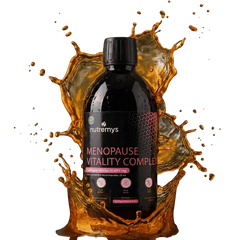
Menopause Vitality Complex combine collagène marin hydrolysé, vitamines B, acide hyaluronique et trois plantes adaptogènes ciblées (trèfle rouge, dong quai, maca) dans une formule liquide à haute biodisponibilité. Conçue pour soutenir aussi bien les fluctuations de la périménopause que les enjeux structurels de la post-ménopause.
Découvrir Menopause Vitality Complex →


Les informations partagées sur ce blog sont à titre éducatif et informatif. Elles ne remplacent en aucun cas une consultation médicale, un diagnostic ou un traitement prescrit par un professionnel de santé. Si vous présentez des symptômes, suivez un traitement ou êtes enceinte, consultez votre médecin avant de modifier votre alimentation ou de débuter une supplémentation. Les compléments alimentaires Nutremys LAB ne sauraient se substituer à un régime alimentaire varié et équilibré, ni à un mode de vie sain.
