

Un bon supplément ménopause ne se résume pas à un seul ingrédient — il repose sur une synergie scientifiquement pensée
Vous cherchez le meilleur supplément pour la ménopause ? La réponse ne se trouve pas dans une marque, mais dans une formulation. La ménopause provoque une cascade de changements hormonaux qui affectent les os, la peau, le sommeil, l'humeur et la digestion. Un complément alimentaire ménopause efficace doit cibler simultanément ces cinq axes avec des actifs dosés à des niveaux cliniquement validés — et non des micro-doses décoratives.
Dans cet article, nous décryptons les 6 ingrédients que la science recommande pour un meilleur accompagnement de la ménopause, les critères de choix d'un bon complément et les pièges à éviter.
Pourquoi la ménopause augmente les besoins en supplémentation

La chute des estrogènes à la ménopause ne se limite pas aux bouffées de chaleur. Elle déclenche une série de déséquilibres métaboliques qui touchent la quasi-totalité des systèmes corporels. Les os perdent en densité, le risque cardiovasculaire augmente, la peau s'amincit, le sommeil se dégrade et le microbiote intestinal et vaginal se déséquilibre. Comprendre ces mécanismes est la première étape pour identifier le meilleur supplément pour la ménopause adapté à vos besoins.
Les 5 grands axes qu'un complément ménopause doit couvrir
Un supplément conçu pour la ménopause doit agir sur cinq fronts simultanément. Un complément mono-ingrédient, aussi bon soit-il, ne peut pas répondre à l'ensemble de ces besoins. La synergie est la clé.
Préserver la densité osseuse face à la perte accélérée post-ménopause
Soutenir le système nerveux et la qualité du repos nocturne
Protéger le système cardiovasculaire et stabiliser l'humeur
Contrer la perte de collagène cutané et la sécheresse
Rééquilibrer la flore intestinale et vaginale altérée
La ménopause n'est pas une maladie — c'est une transition physiologique. Mais elle crée des besoins nutritionnels spécifiques que l'alimentation seule ne couvre pas toujours, surtout face à la carence en vitamine D (déficiente chez plus de 80 % des Européennes), au manque de magnésium (70 % des Françaises en dessous des apports recommandés) et à l'insuffisance en calcium. Un supplément bien formulé comble ces déficits de façon ciblée.
Les 6 ingrédients d'un complément alimentaire ménopause efficace
Pour être considéré comme le meilleur supplément pour la ménopause, un complément alimentaire doit réunir ces six actifs à des dosages cliniquement validés. Voici pourquoi chacun est essentiel — et sous quelle forme le privilégier.
Os, peau, articulations
Absorption calcique, immunité
Sommeil, stress, cofacteur D3
Cœur, humeur, inflammation
Si apports alimentaires insuffisants
Microbiote intestinal & vaginal
🐟 Collagène marin hydrolysé — le pilier structurel de la ménopause
Le collagène représente 30 % des protéines du corps et constitue la trame organique des os, du cartilage et de la peau. À la ménopause, la production endоgène de collagène chute brutalement avec les estrogènes, accélérant la perte osseuse et le vieillissement cutané. Un collagène marin hydrolysé en peptides bioactifs (5 à 10 g/jour) a démontré dans des essais contrôlés randomisés sa capacité à améliorer la densité minérale osseuse et l'élasticité cutanée chez les femmes ménopausées. La forme hydrolysée est essentielle : elle offre une biodisponibilité supérieure à 90 % grâce à un poids moléculaire réduit qui facilite l'absorption intestinale.
☀️ Vitamine D3 — corriger la carence vitamine D ménopause
Sans vitamine D3, l'organisme n'absorbe que 10 à 15 % du calcium alimentaire — un taux dramatiquement insuffisant pour maintenir la densité osseuse. La vitamine D3 (cholécalciférol) est la forme la plus efficace car elle correspond à celle synthétisée naturellement par la peau sous l'effet du soleil. L'EFSA reconnaît son rôle dans le maintien d'une ossature normale, d'une fonction musculaire normale et d'une réduction du risque de chute chez les personnes de plus de 60 ans. En Europe, plus de 80 % des femmes ménopausées présentent un taux insuffisant de vitamine D — ce qui en fait la carence la plus urgente à corriger.
⚙️ Magnésium bisglycinate — le cofacteur oublié
Le magnésium est le grand oublié des formules ménopause — alors qu'il intervient dans plus de 300 réactions enzymatiques. Il est indispensable à la conversion de la vitamine D en sa forme active (calcitriol) et à la régulation de la parathormone. Une étude menée à Grenade sur 52 femmes ménopausées a montré qu'une supplémentation en magnésium (500 mg/jour pendant 8 semaines) améliorait significativement le statut en vitamine D. Le bisglycinate est la forme la mieux tolérée et la plus biodisponible — elle n'entraîne pas les troubles digestifs courants avec l'oxyde de magnésium.

🐟 Oméga-3 EPA/DHA — protection cardiovasculaire et stabilité émotionnelle
La chute des estrogènes supprime leur effet cardioprotecteur, augmentant le risque cardiovasculaire de manière significative après la ménopause. Les oméga-3, en particulier l'EPA et le DHA, exercent un puissant effet anti-inflammatoire, soutiennent la santé vasculaire et contribuent à stabiliser l'humeur. Des revues systématiques récentes ont montré que la supplémentation en oméga-3 pouvait réduire les symptômes dépressifs associés à la ménopause. L'EFSA recommande un apport minimal de 250 mg d'EPA + DHA par jour pour le maintien d'une fonction cardiaque normale.
🦴 Calcium — en complément de l'alimentation
Le calcium reste le minéral de construction osseuse par excellence. Mais attention : il ne doit être supplémenté que si les apports alimentaires sont insuffisants (moins de 800 mg/jour). L'EFSA autorise l'allégation selon laquelle les produits apportant au moins 400 mg de calcium par portion contribuent à réduire la perte de densité minérale osseuse chez les femmes ménopausées de 50 ans et plus. Le citrate de calcium est préférable au carbonate chez les femmes avec peu d'acidité gastrique — un phénomène fréquent après 50 ans.
🦠 Probiotiques ciblés — rééquilibrer le microbiote
La ménopause bouleverse la composition du microbiote vaginal et intestinal. La baisse des estrogènes réduit la population de lactobacilles protecteurs, augmentant la vulnérabilité aux infections et aux troubles digestifs. Des souches spécifiques comme Lactobacillus rhamnosus, Lactobacillus reuteri et Bifidobacterium bifidum ont montré leur capacité à restaurer l'équilibre de la flore et à améliorer le confort digestif. Un probiotique de qualité doit contenir des souches cliniquement documentées à des concentrations suffisantes (au moins 10 milliards d'UFC).
Ces six ingrédients ne fonctionnent pas indépendamment les uns des autres. Le magnésium active la vitamine D, qui permet l'absorption du calcium, qui se fixe sur la trame de collagène osseuse. Les oméga-3 modulent l'inflammation qui accélère la résorption osseuse. Et les probiotiques optimisent l'absorption intestinale de l'ensemble des nutriments. C'est cette synergie qui fait la différence entre un complément qui fonctionne et un simple marketing nutritionnel.
Une formule qui réunit ces 6 actifs en synergie
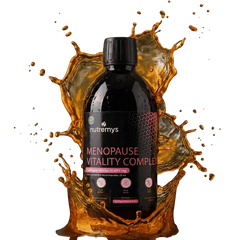
Collagène marin hydrolysé, vitamine D3, magnésium — découvrez notre formule pensée pour accompagner la ménopause avec science et douceur.
Découvrir Menopause Vitality →Collagène ménopause, vitamine D et magnésium : ce que disent les études
Un bon supplément pour la ménopause ne repose pas sur des promesses — il s'appuie sur des données cliniques. Voici les études les plus robustes qui fondent la sélection de ces ingrédients.

Essai contrôlé randomisé, en double aveugle, mené sur 131 femmes ménopausées. La prise quotidienne de 5 g de peptides de collagène pendant 12 mois a entraîné une augmentation statistiquement significative de la densité minérale osseuse au niveau de la colonne vertébrale et du col du fémur, par rapport au groupe placebo. Une étude de suivi sur 4 ans a confirmé la durabilité de ces résultats.
Une méta-analyse publiée en 2025 a analysé l'ensemble des essais randomisés évaluant l'effet du collagène seul ou combiné au calcium et à la vitamine D. Conclusion : la combinaison des trois actifs surpassait systématiquement le calcium + vitamine D seuls en termes d'amélioration de la densité minérale osseuse, confirmant l'importance de la synergie.
52 femmes ménopausées en bonne santé ont reçu 500 mg/jour de magnésium ou un placebo pendant 8 semaines. Le groupe magnésium a présenté une augmentation significative du statut en vitamine D par rapport au groupe contrôle — même sans supplémentation directe en vitamine D. Cela confirme le rôle du magnésium comme cofacteur indispensable.
L'Autorité européenne de sécurité des aliments reconnaît officiellement que le calcium et la vitamine D contribuent à réduire la perte de densité minérale osseuse chez les femmes ménopausées de plus de 50 ans (de 400 mg de calcium et 800 UI de vitamine D3 par jour). Le magnésium bénéficie d'allégations validées sur la réduction de la fatigue, le fonctionnement normal du système nerveux et le maintien d'une ossature normale. Ce sont les seuls ingrédients disposant d'allégations de santé officiellement validées par les autorités européennes dans le cadre de la ménopause.
Les preuves scientifiques convergent vers une approche synergique. Le meilleur supplément pour la ménopause n'est pas celui qui contient l'ingrédient le plus « à la mode », mais celui qui associe des actifs complémentaires à des dosages cliniques. Un collagène sous-dosé à 2 g, une vitamine D à 200 UI ou un magnésium sous forme d'oxyde peu absorbé ne produiront pas les effets observés dans les études. La forme et la dose comptent autant que le choix de l'ingrédient.
Choisir un supplément ménopause sans phytooestrogènes : les 5 critères
Tous les compléments ménopause ne se valent pas. Voici les cinq critères essentiels pour distinguer une formule efficace d'un produit purement marketing. Ces principes s'appliquent quel que soit le complément que vous choisissez — y compris ceux disponibles dans notre guide des compléments essentiels après 50 ans.
Privilégiez le citrate de calcium (plutôt que le carbonate), le bisglycinate de magnésium (plutôt que l'oxyde), la vitamine D3 (plutôt que la D2) et un collagène marin hydrolysé (plutôt qu'un collagène non hydrolysé ou bovin). La biodisponibilité détermine la quantité réellement absorbée par l'organisme — et peut varier du simple au triple selon la forme choisie.
Beaucoup de compléments affichent une longue liste d'ingrédients mais à des dosages insuffisants pour produire un effet réel. Vérifiez que les quantités correspondent aux dosages utilisés dans les études cliniques : au moins 5 g de collagène, 1 000 UI de vitamine D3, 300 mg de magnésium élémentaire. Un ingrédient bien dosé vaut mieux que dix ingrédients sous-dosés.
Les phytooestrogènes (isoflavones de soja, trèfle rouge) sont contre-indiqués chez les femmes ayant des antécédents de cancers hormonodépendants. Un bon supplément ménopause universel doit être formulé sans ces composés pour convenir au plus grand nombre. Les femmes souhaitant intégrer des phytooestrogènes doivent le faire sous contrôle médical et de manière séparée.
Exigez un étiquetage complet avec la quantité exacte de chaque actif, l'origine des ingrédients et les certifications qualité. Méfiez-vous des « formules propriétaires » qui masquent les dosages individuels derrière un mélange global. La transparence est le premier signe de sérieux d'un laboratoire.
Le meilleur supplément pour la ménopause n'est pas celui qui contient le plus d'ingrédients, mais celui dont les actifs travaillent ensemble de façon cohérente. Le magnésium active la vitamine D, la vitamine D permet l'absorption du calcium, le calcium se fixe sur la trame de collagène. Cette logique de synergie doit être visible dans la conception du produit. Un complément qui combine collagène + vitamine D + magnésium + calcium dans des proportions étudiées sera toujours plus efficace qu'une collection de gélules mono-ingrédient prises séparément.
Ce qu'un bon complément ménopause ne devrait PAS contenir
À l'inverse, certains ingrédients fréquemment inclus dans les compléments ménopause n'ont pas de preuves solides d'efficacité — ou présentent des risques que vous devez connaître.
Souvent promue contre les bouffées de chaleur, la vitamine E isolée à forte dose n'a montré qu'un effet minime dans les études. Pire, un apport excessif a été associé à une augmentation de la mortalité dans certaines méta-analyses. L'apport via l'alimentation (huiles végétales, oléagineux) reste largement suffisant.
La DHEA est une hormone précurseur des estrogènes. Son utilisation en supplémentation relève du suivi hormonal médical et ne devrait jamais être présente dans un complément alimentaire en vente libre. Les autorités sanitaires européennes sont strictes à ce sujet.
Bien que l'igname sauvage serve de base pour fabriquer des hormones de synthèse en laboratoire, le corps humain ne possède pas les enzymes nécessaires pour effectuer cette conversion. Les compléments à base d'igname sauvage n'ont jamais démontré d'efficacité dans les essais cliniques sur les symptômes de la ménopause.
Les isoflavones de soja et le trèfle rouge sont des phytooestrogènes qui agissent sur les récepteurs estrogéniques. Depuis 2012, l'EFSA a interdit aux compléments contenant des isoflavones de revendiquer un soulagement des bouffées de chaleur ou un maintien de la densité osseuse, faute de preuves suffisantes. De plus, ces composés sont contre-indiqués en cas d'antécédents de cancers hormonodépendants (sein, utérus, ovaire). Ils ne devraient être envisagés qu'après un avis médical individualisé.
FAQ — Questions fréquentes sur le meilleur supplément ménopause
Découvrez notre formule conçue pour accompagner la ménopause avec science et douceur
Collagène marin hydrolysé, vitamine D3, magnésium… une synergie d'actifs formulée pour soutenir votre vitalité, votre confort et votre capital osseux pendant la ménopause.
Explorez la formule Menopause Vitality →doi.org/10.3390/nu10010097
pubmed.ncbi.nlm.nih.gov/34520654
pubmed.ncbi.nlm.nih.gov/41049371
pmc.ncbi.nlm.nih.gov/PMC7468838
efsa.europa.eu
anses.fr
vidal.fr



Les informations partagées sur ce blog sont à titre éducatif et informatif. Elles ne remplacent en aucun cas une consultation médicale, un diagnostic ou un traitement prescrit par un professionnel de santé. Si vous présentez des symptômes, suivez un traitement ou êtes enceinte, consultez votre médecin avant de modifier votre alimentation ou de débuter une supplémentation. Les compléments alimentaires Nutremys LAB ne sauraient se substituer à un régime alimentaire varié et équilibré, ni à un mode de vie sain.
