

Cet article compare les types de collagène pour vous aider à faire le bon choix. Pour comprendre les mécanismes biologiques et la chronologie des résultats, lisez notre guide scientifique : Collagène marin et ménopause : ce que dit la science →
Ce que vous allez lire dans cet article
La ménopause ne modifie pas le corps de façon uniforme. Elle cible précisément les tissus dont le renouvellement est régulé par les œstrogènes — et le collagène fait partie de ces tissus. Comprendre ce mécanisme, c'est comprendre comment lire une étiquette de complément alimentaire avec les bons critères.
Cet article examine les différences biologiquement pertinentes entre les sources, les états moléculaires et les dosages de collagène disponibles. Il compare le collagène marin, bovin et végétal sur des bases scientifiques documentées. Il précise les dosages efficaces, les cofacteurs indispensables, et la chronologie réaliste des résultats observés dans les études cliniques. Chaque affirmation est sourcée. Chaque limite est nommée.
Cet article est à titre informatif et ne remplace pas un avis médical personnalisé. Consultez votre médecin ou votre gynécologue avant d'initier toute supplémentation, en particulier si vous suivez un traitement hormonal de la ménopause ou un traitement anticoagulant.
Ce que la ménopause fait au collagène — le mécanisme exact
Avant de comparer les formules, il faut comprendre ce qui change biologiquement à la ménopause. Cette compréhension est précisément ce qui rend un choix de supplémentation pertinent plutôt qu'arbitraire — et ce qui vous permettra de ne pas être trompée par des arguments qui sonnent juste sans l'être.
Le collagène est une famille de protéines fibreuses qui constituent la matrice extracellulaire de la plupart des tissus conjonctifs. Il existe 28 types distincts. Le type I — le plus abondant dans l'organisme — forme les fibres qui donnent résistance et densité à la peau, aux tendons et aux os. Le type III est associé à l'élasticité cutanée et vasculaire. Ce sont précisément ces deux types qui déclinent le plus rapidement à la ménopause, pour une raison mécanique très précise.
Les fibroblastes cutanés, les ostéoblastes et les chondrocytes portent des récepteurs aux œstrogènes (RE-α et RE-β). Ces récepteurs ne sont pas là par coïncidence : les œstrogènes exercent une double régulation sur le métabolisme du collagène. Ils activent la transcription des gènes responsables de la synthèse de collagène de type I et III — en d'autres termes, ils commandent la production. Simultanément, ils inhibent les métalloprotéinases matricielles (MMP), les enzymes chargées de dégrader les fibres vieillissantes.
Quand les œstrogènes chutent à la ménopause, ces deux régulations s'effondrent en même temps. La synthèse ralentit. La dégradation s'accélère. C'est un effet ciseaux documenté : une étude publiée dans le British Journal of Dermatology (Brincat et al., 1987) a mesuré une perte d'environ 2 % de collagène cutané par an à partir de la ménopause, avec une chute initiale pouvant atteindre 30 % dans les cinq premières années. Ces données ont depuis été confirmées par imagerie dermique à ultrasons, qui quantifie directement la densité des fibres dans le derme.
Au-delà de la peau : os, articulations, tissu conjonctif profond
Ce déclin ne se limite pas à la sphère cutanée — et c'est important à comprendre pour évaluer l'intérêt d'une supplémentation sur l'ensemble du tissu conjonctif. Le collagène représente environ 30 % de la masse osseuse : c'est la trame organique sur laquelle se fixent les cristaux d'hydroxyapatite. Son appauvrissement explique en partie pourquoi la densité osseuse diminue si rapidement après la ménopause, et pourquoi un apport de calcium seul ne suffit pas sans l'infrastructure protéique qui le retient.
Le cartilage articulaire — constitué à 60–70 % de collagène de type II — est lui aussi concerné. Son amincissement progressif contribue aux douleurs articulaires que de nombreuses femmes décrivent dès la périménopause, parfois plusieurs années avant l'arrêt des règles. Le tissu conjonctif du plancher pelvien, riche en types I et III, participe également à ce mouvement général de fragilisation — ce qui explique l'augmentation du risque de prolapsus et d'incontinence d'effort dans les années qui suivent la ménopause.
Le collagène n'est pas un actif cosmétique parmi d'autres. C'est une protéine structurelle dont le déclin à la ménopause a des conséquences biologiques mesurables sur la peau, les os, les articulations et le tissu conjonctif profond. Cette distinction change radicalement la façon dont on évalue une supplémentation — et les attentes qu'on en a.

Quel collagène pour la ménopause : les quatre critères décisifs
La question "quel collagène pour la ménopause" ne reçoit pas une réponse unique, parce qu'elle en recouvre quatre distinctes. L'origine de la matière première. L'état moléculaire du produit fini. Le dosage journalier. La forme galénique. Ces quatre paramètres déterminent ensemble l'efficacité réelle d'un complément — et aucun ne peut être évalué indépendamment des autres.
Marine, bovine, porcine. Chaque source présente un profil d'acides aminés et une taille moléculaire distincts, avec des implications directes sur la biodisponibilité et la pertinence pour la ménopause.
Natif ou hydrolysé. C'est la distinction la plus importante — et la plus fréquemment occultée. Elle détermine si le collagène peut traverser la muqueuse intestinale ou non.
La littérature clinique situe la fourchette efficace entre 5 000 et 10 000 mg de peptides de collagène hydrolysé par jour. En dessous de 2 500 mg, les effets sont marginaux dans la majorité des protocoles publiés.
Liquide ou gélule. La forme conditionne la vitesse et le taux d'absorption — avec des avantages pharmacocinétiques documentés pour la forme liquide, notamment après 50 ans.
Ces quatre critères forment un tout. Un collagène marin hydrolysé à 10 000 mg sous forme liquide est sans équivalent avec un collagène marin non hydrolysé à la même dose — la biodisponibilité n'est pas comparable. Inversement, une forme liquide bien formulée ne compense pas un défaut d'hydrolyse. La lecture d'étiquette efficace consiste à vérifier les quatre paramètres simultanément.
La méta-analyse de León-López et al. (2019), publiée dans Nutrients et couvrant 1 125 participants dans 11 essais randomisés contrôlés, confirme la fourchette de 5 000 à 10 000 mg de peptides hydrolysés par jour comme seuil de pertinence clinique, avec un profil de sécurité excellent sur des durées allant jusqu'à six mois. Ces résultats concernent spécifiquement les peptides hydrolysés — non le collagène natif. La forme moléculaire est une variable de l'essai, pas un détail de packaging.
Collagène marin, bovin, végétal — une comparaison objective
Trois grandes catégories de collagène coexistent sur le marché des compléments alimentaires. Leur comparaison rigoureuse repose sur des critères biologiques mesurables — pas sur des arguments de tendance.
| Source | Types principaux | Profil pour la ménopause | Points de vigilance |
|---|---|---|---|
| Marin (poisson) | Type I majoritaire | Profil d'acides aminés structurellement proche du collagène humain. Taille moléculaire initiale plus réduite — hydrolyse plus efficace. Trazabilité contrôlable. | Allergies aux produits de la mer. Vérifier l'espèce, la partie utilisée (peau, écailles) et le procédé d'hydrolyse. |
| Bovin | Types I et III | Standard de référence dans de nombreuses études cliniques. Bonne biodisponibilité une fois hydrolysé. Fournit types I et III simultanément. | Trazabilité variable selon les pratiques d'élevage. Risque de résidus selon la certification. Incompatible avec certaines pratiques alimentaires. |
| Porcin | Types I et III | Profil comparable au bovin. Moins présent dans les études cliniques récentes. | Incompatible avec les régimes halal, casher ou végétariens. Trazabilité à vérifier. |
| "Végétal" | Aucun collagène | Ne contient pas de collagène — contient des précurseurs (vitamine C, glycine, proline) qui soutiennent la synthèse endogène, sans se substituer aux peptides hydrolysés. | L'appellation est trompeuse. L'action est réelle mais distincte — elle agit sur les cofacteurs de synthèse, non sur l'apport de peptides directement assimilables. |
Une précision sur le "collagène végétal" mérite d'être développée, parce que la confusion commerciale est fréquente. Le collagène est une protéine exclusivement animale — il n'existe pas dans le règne végétal. Les formules commercialisées sous cette appellation contiennent des précurseurs de la synthèse endogène : acides aminés (glycine, proline, hydroxyproline), vitamine C, parfois silicium ou biotine. Ces nutriments ont une utilité réelle et documentée, mais ils n'apportent pas les peptides Pro-Hyp et Hyp-Gly qui constituent le mécanisme d'action spécifique du collagène hydrolysé. Ce sont deux stratégies biologiquement distinctes — complémentaires, non équivalentes.
Pour les femmes en ménopause, l'avantage spécifique du collagène marin tient à deux éléments documentés : son profil d'acides aminés est plus proche de celui du collagène humain que celui du collagène bovin, ce qui favorise une reconnaissance optimale par les fibroblastes ; et sa taille moléculaire initiale plus réduite permet une hydrolyse produisant des peptides de poids moléculaire plus faible, avec une absorption intestinale correspondante plus rapide. Sa trazabilité — espèce, partie anatomique, procédé d'hydrolyse, certifications — est également plus facile à vérifier que celle des collagènes issus d'élevages terrestres, dont les matrices peuvent contenir des résidus selon les pratiques de production.

Hydrolysé ou natif : la question que les étiquettes évitent de poser
L'appellation "collagène" sans autre précision ne distingue pas les formes moléculaires. C'est un point critique pour l'évaluation d'un complément — peut-être le plus critique de tous — et c'est précisément là que les communications marketing ont tendance à s'arrêter avant d'entrer dans les détails.
Le collagène natif — qu'il soit marin, bovin ou autre — est une triple hélice de trois chaînes polypeptidiques enroulées l'une autour de l'autre. Sa masse moléculaire dépasse 300 000 daltons. Cette architecture, précisément ce qui lui confère sa résistance mécanique dans les tissus biologiques, est aussi ce qui rend son absorption intestinale biologiquement impossible sous cette forme. Les enzymes digestives — pepsine, trypsine, chymotrypsine — le décomposent en acides aminés libres, principalement glycine, proline et hydroxyproline, qui entrent dans le pool général des acides aminés. Ces acides aminés sont utiles à l'organisme, mais ils ne fournissent pas les peptides spécifiques qui activent directement les fibroblastes.
Ce que l'hydrolyse change concrètement
L'hydrolyse enzymatique brise les liaisons peptidiques de façon contrôlée, réduisant le poids moléculaire à moins de 3 000 daltons. Les fragments résultants — en particulier les dipeptides Pro-Hyp (proline-hydroxyproline) et Hyp-Gly (hydroxyproline-glycine) — franchissent la muqueuse intestinale par des transporteurs spécifiques (PEPT1 et PEPT2). Une fois dans la circulation sanguine, ils sont détectables 30 à 120 minutes après ingestion, selon une étude publiée dans le Journal of Agricultural and Food Chemistry (Iwai et al., 2005). Ils atteignent ensuite les fibroblastes dermiques et les ostéoblastes, où ils sont reconnus comme un signal de dégradation du tissu conjonctif. L'organisme répond en augmentant sa synthèse de collagène endogène — un mécanisme documenté in vitro et confirmé par les taux plasmatiques de procollagène mesurés dans les essais cliniques.
Ce mécanisme explique pourquoi la qualité de l'hydrolyse — le degré de dépolymérisation et le profil peptidique qui en résulte — est aussi déterminante que la concentration brute affichée sur l'étiquette. Un produit qui indique "10 000 mg de collagène" sans préciser "hydrolysé" ou "peptides de collagène" ne garantit pas une biodisponibilité équivalente à celle d'un produit correctement caractérisé. La vérification de ce détail est le geste de lecture d'étiquette le plus déterminant.
La forme liquide : un avantage pharmacocinétique documenté
La forme galénique prolonge la logique de la biodisponibilité. Une gélule contenant des peptides de collagène hydrolysé doit d'abord se dissoudre dans l'estomac avant que les peptides puissent entrer en contact avec la muqueuse intestinale. La forme liquide supprime cette étape. Les concentrations plasmatiques en peptides actifs sont plus élevées dans les deux premières heures post-ingestion, ce qui est particulièrement pertinent pour les femmes dont la sécrétion d'acide gastrique diminue physiologiquement avec l'âge — une évolution fréquente après 50 ans qui peut réduire l'efficacité de la dissolution des gélules.
"Collagen 10 000 mg" → Sans mention "hydrolysé" ou "peptides", l'absorption est incertaine.
"Peptides de collagène hydrolysé 10 000 mg" → La forme moléculaire est précisée. Si le poids moléculaire est indiqué (< 3 000 Da), c'est un signe de transparence supplémentaire.
La différence entre ces deux formulations n'est pas un détail de rédaction — c'est une distinction biochimique avec des conséquences sur l'efficacité réelle du produit.
Posologie, timing et cofacteurs indispensables
La dose est la variable la plus souvent négligée dans la communication autour des compléments alimentaires — et pourtant la plus déterminante pour l'efficacité. Les études cliniques qui montrent des résultats mesurables sur la peau utilisent des doses comprises entre 5 000 et 10 000 mg de peptides de collagène hydrolysé par jour. La méta-analyse de León-López et al. (2019), parue dans Nutrients, confirme cette fourchette sur 1 125 participants et note un profil de sécurité excellent sur six mois. En dessous de 2 500 mg par jour, les effets sont marginaux dans la grande majorité des protocoles publiés.
Le timing : la régularité avant tout
Le moment de la prise influence l'absorption sans en être le facteur déterminant. La régularité quotidienne l'emporte sur le choix du moment. Cela dit, deux fenêtres offrent des avantages physiologiques documentés.
| Moment | Avantage physiologique | Condition | Pertinence |
|---|---|---|---|
| Matin à jeun | Absorption maximale — aucune compétition avec les protéines alimentaires pour les transporteurs intestinaux | Estomac vide depuis au moins 2 heures | Idéal |
| 30 min avant le repas | Bon compromis entre absorption et tolérance digestive | Estomac semi-vide | Très bon |
| Post-effort sportif | La fenêtre anabolique post-exercice favorise la synthèse protéique — bénéfice osseux et articulaire accru | Associé à une source de vitamine C | Excellent si activité physique régulière |
| Soir avant dormir | Coïncide avec le pic d'hormone de croissance nocturne qui optimise la synthèse protéique | 2 heures après le dîner | Excellent si jeun respecté |
| Pendant le repas | Pratique, aucun risque digestif | Aucune contrainte particulière | Acceptable — absorption moindre |
Les cofacteurs que la synthèse ne peut pas contourner
Le collagène ne travaille pas seul. Trois micronutriments potentialisent son action de façon documentée et méritent d'être systématiquement associés à chaque prise — leur absence peut neutraliser partiellement l'efficacité d'un apport peptidique pourtant optimal.
La vitamine C est la plus critique. En tant que cofacteur des enzymes prolyl hydroxylase et lysyl hydroxylase, elle est indispensable à la stabilisation des triples hélices de collagène néoformées. Sans elle, la synthèse est biologiquement bloquée en aval de l'apport peptidique — c'est le mécanisme qui explique les manifestations cutanées sévères du scorbut. Conformément au Règlement UE n° 432/2012, la vitamine C "contribue à la formation normale du collagène pour une fonction normale de la peau". Une étude de Shaw et al. (2017), publiée dans l'American Journal of Clinical Nutrition, a mesuré un doublement des taux sanguins de collagène synthétisé lorsque les peptides étaient associés à de la vitamine C, par rapport à une prise de collagène seul.
Le zinc régule l'activité des métalloprotéinases matricielles, contribuant à freiner la dégradation du collagène existant. L'acide hyaluronique, qui fixe jusqu'à mille fois son poids en eau dans le derme, complète l'action structurelle du collagène en restaurant la turgescence du tissu et la densité visuelle de la peau. Ces trois cofacteurs, idéalement intégrés dans une même formule, évitent la complexité de prises multiples et garantissent leur disponibilité simultanée au moment où les peptides atteignent les fibroblastes.
Prendre le collagène sans source de vitamine C simultanée. La synthèse ne peut pas s'opérer sans ce cofacteur enzymatique — quelle que soit la qualité des peptides apportés. Si ta formule ne l'intègre pas, associe systématiquement ta prise à un aliment riche en vitamine C (kiwi, poivron cru, agrumes) ou à un complément dédié.
Second point de vigilance : la chaleur dégrade les peptides. Ne jamais dissoudre un collagène en poudre dans un liquide à plus de 70°C. La forme liquide hydrolysée se consomme pure ou mélangée à une boisson froide ou tiède — ce qui élimine ce risque.
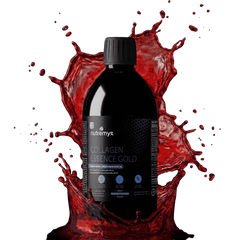
12 500 mg de collagène marin hydrolysé.
Avec vitamine C, acide hyaluronique et rétinol.
Collagen Essence Gold associe les quatre critères de sélection décrits dans cet article : origine marine, hydrolyse enzymatique, dosage cliniquement pertinent, forme liquide à biodisponibilité jusqu'à 3 fois supérieure aux gélules. Clean label. Fabrication européenne. Certifié GMP, HACCP, ISO 22000.
Voir Collagen Essence Gold →Les signes que votre tissu conjonctif réclame un apport complémentaire
Certains signaux fonctionnels peuvent indiquer que le tissu conjonctif traverse une période de fragilisation accélérée — ce qui est fréquent dans les cinq premières années suivant le début de la ménopause. Ces signes ne constituent pas un diagnostic. Ils fournissent des points de repère pour évaluer l'opportunité d'une supplémentation en accord avec votre médecin, et pour distinguer ce qui relève d'un apport nutritionnel insuffisant de ce qui nécessite une prise en charge médicale spécifique.
Perte de fermeté et de densité perceptible à la palpation. Sécheresse persistante résistant aux soins topiques. Apparition de rides fines là où la peau était antérieurement lisse. Modification du contour du visage indépendante d'une variation de poids.
Raideur matinale prolongée dans les mains, genoux ou hanches, supérieure à 30 minutes. Réduction progressive de l'amplitude des mouvements. Douleurs articulaires diffuses à l'effort modéré qui n'étaient pas présentes avant la ménopause.
Ongles qui se fragilisent et se cassent horizontalement ou se dédoublent. Texture capillaire modifiée avec augmentation de la chute diffuse ou de la sécheresse. Ces signes peuvent aussi relever d'une carence en fer ou en biotine — un bilan biologique est recommandé.

Ces manifestations ne sont pas exclusivement dues à un déficit en collagène. D'autres carences — fer, vitamine D, protéines totales, zinc — peuvent produire des tableaux similaires ou s'y superposer. La démarche pertinente consiste à réaliser un bilan biologique avant de conclure à une cause unique. L'objectif de cette liste n'est pas d'attribuer une causalité certaine, mais de nommer les signaux qui, dans le contexte de la ménopause, méritent une attention nutritionnelle structurée — et un dialogue ouvert avec votre médecin.
Une cure minimale de trois mois est nécessaire pour évaluer l'efficacité d'une supplémentation en collagène sur la peau. Six mois pour les effets osseux et articulaires. La production de collagène est un processus biologique lent — les attentes irréalistes constituent la principale cause d'abandon prématuré, souvent au moment précis où les premiers effets commencent à se manifester.
L'arrêt de la supplémentation entraîne un retour progressif à la situation initiale en quatre à six semaines. Ce délai plaide pour une prise continue ou une dose d'entretien de 5 000 mg/jour après la cure initiale, plutôt que des cures fragmentées.
Ce que le collagène marin ne fait pas — les limites à nommer
La crédibilité scientifique s'acquiert aussi par ce qu'on ne dit pas. Le collagène marin ne régule pas les hormones. Il n'agit pas sur les récepteurs aux œstrogènes, ne contribue pas à la réduction des bouffées de chaleur, ne modifie pas la qualité du sommeil perturbée par la ménopause et ne soutient pas l'axe hypothalamo-hypophysaire. Pour ces symptômes, d'autres actifs — phytoestrogènes de soja et de trèfle rouge, Dong Quai, maca, vitamines B — ont des mécanismes d'action documentés que le collagène n'a pas.
Il ne remplace pas non plus un traitement hormonal de la ménopause. Ce sont deux interventions avec des cibles biologiques distinctes : l'une agit sur la trame structurelle du tissu conjonctif, l'autre sur la régulation hormonale qui la gouverne. Une femme sous traitement hormonal peut bénéficier d'une supplémentation en collagène en complément — les œstrogènes exogènes restaurent partiellement la régulation des fibroblastes, et le collagène fournit le substrat de synthèse — mais les deux approches ne se substituent pas l'une à l'autre.
Questions fréquentes sur le choix du collagène à la ménopause
doi.org/10.1111/j.1365-2133.1987.tb04228.x
doi.org/10.1159/000355523
doi.org/10.3390/nu11122557
doi.org/10.1021/jf048166l
doi.org/10.3390/nu10010097
doi.org/10.3945/ajcn.116.138594
pubmed.ncbi.nlm.nih.gov/41049371
efsa.europa.eu



Les informations partagées sur ce blog sont à titre éducatif et informatif. Elles ne remplacent en aucun cas une consultation médicale, un diagnostic ou un traitement prescrit par un professionnel de santé. Si vous présentez des symptômes, suivez un traitement ou êtes enceinte, consultez votre médecin avant de modifier votre alimentation ou de débuter une supplémentation. Les compléments alimentaires Nutremys LAB ne sauraient se substituer à un régime alimentaire varié et équilibré, ni à un mode de vie sain.
