

Is marine collagen dangerous? What science really says
Documented side effects, hepatic impact, actual contraindications: a rigorous analysis to help you decide for yourself, with verifiable data.
Direct Answer
No, marine collagen is not dangerous for the vast majority of healthy women. Documented side effects are rare, mild, and transient — mainly digestive. Actual and verified contraindications concern individuals allergic to fish, pregnant or breastfeeding women, and certain severe kidney conditions.
The main risk does not come from the molecule itself, but from the product's manufacturing quality: traces of heavy metals, unverified dosages, lack of traceability. Choosing hydrolyzed collagen manufactured in Europe, certified GMP and HACCP, eliminates most of these risks. This is documented, source by source, in the rest of this article.
Marine Collagen: What exactly is it?
Before assessing its risks, we must understand what we are ingesting. Collagen is the most abundant structural protein in the human body: it represents about 30% of total protein mass and forms the framework of skin, bones, cartilage, tendons, and vascular walls. From the age of 25, the natural synthesis of collagen decreases at an estimated rate of 1 to 1.5% per year. This decline significantly accelerates during perimenopause, due to decreasing estrogen levels — hormones that play a direct role in activating fibroblasts, the cells that produce collagen.
Marine collagen is extracted from the skin, scales, or bones of fish — most often tilapia, cod, or salmon. It is primarily composed of type I collagen, the most prevalent in skin and tendons. The fundamental difference from bovine or porcine collagen lies in its amino acid composition: richer in hydroxyproline and glycine, it offers a profile particularly suited to the synthesis of skin peptides.
The term hydrolyzed collagen refers to collagen that has undergone enzymatic hydrolysis: long protein chains are broken down into low molecular weight peptides, generally less than 3,000 Daltons. It is this step that gives marine collagen its superior bioavailability: shorter peptides cross the intestinal barrier with an efficiency that intact proteins do not achieve.

collagen synthesis per year after age 25
Varani et al., 2006
of total human body protein is collagen
EFSA, 2005
molecular weight of hydrolyzed peptides for optimal absorption
Oesser et al., 1999
Key takeaway
Hydrolyzed marine collagen is not an exotic ingredient. It is an enzymatically cleaved protein fraction, absorbed in part as dipeptides and tripeptides via intestinal transporters. Its chemical structure is similar to human collagen — which is precisely what makes it useful as a supplement.
The real dangers of marine collagen: documented side effects
The available scientific literature is clear on this point: adverse effects of hydrolyzed marine collagen are documented, but they remain rare, benign, and reversible in the vast majority of cases. Here's what is known with certainty.
Digestive Issues
The most frequently reported effects in clinical studies are mild digestive discomforts: nausea, bloating, a feeling of gastric heaviness, or a persistent fishy aftertaste. These primarily occur at the beginning of a course of treatment or when the supplement is taken on an empty stomach. These effects are transient—they generally disappear after the first few weeks—and can be alleviated by taking the collagen with a meal or by dividing the daily dose.
Allergic Risk
This is the only clinically significant risk to monitor. Since marine collagen is derived from fish proteins, individuals with a confirmed allergy to fish or seafood may develop an allergic reaction—hives, angioedema in severe cases. This contraindication is absolute. If you have any doubt about sensitivity, a prior skin allergy test is recommended.
The Issue of Contaminants
This is where manufacturing quality becomes crucial. Marine fish accumulate environmental pollutants in their tissues—mercury, lead, cadmium—and traces of these can remain in poorly purified collagen. This risk is real, but it is entirely manageable: it depends on the rigor of the manufacturing process, not on the molecule itself. Marine collagen produced in Europe under GMP, HACCP, and ISO 22000 certification undergoes systematic analytical controls that eliminate this risk.
| Side Effect | Frequency | Evidence Level | Reversible? |
|---|---|---|---|
| Digestive discomfort | Infrequent | Documented | Yes — within a few days |
| Allergic reaction (fish allergy) | Rare (allergic predisposition) | Contraindication | Complete avoidance required |
| Contaminants (heavy metals) | Varies by manufacturer | Quality risk | Eliminated by GMP certification |
| Hepatotoxicity | Not documented | Myth | Not applicable |
| Hypercalcemia | Not documented (marine type I) | Not established | Not applicable |
Marine Collagen and the Liver: Myth or Reality?

This is one of the most common fears, amplified by health forums that cite unverified sources. The question deserves a rigorous answer, because the fear of liver damage is legitimate—and because the biological reality here is much more reassuring than what is often read.
The liver is the central organ for protein metabolism. When you ingest hydrolyzed collagen, the peptides are absorbed in the intestine and transported to the liver via the portal vein, just like all amino acids from food. The liver uses them to synthesize its own proteins, distribute them into circulation, and, if necessary, convert them into glucose or ketone bodies. There is no biochemical reason why marine collagen would stress the liver differently than an egg white or a portion of fish.
Published literature confirms this analysis. No controlled study has documented hepatotoxicity related to pure marine collagen in healthy subjects. ANSES, in its assessment of the risks of collagen-based food supplements (2019), does not mention the liver among the target organs at risk for this molecule.
What's more: glycine, the most abundant amino acid in collagen (about 33% of its composition), has been studied in several contexts for its potentially protective effects on liver cells, particularly in models of steatosis and inflammation. These data are still preliminary and do not constitute a clinical claim, but they radically contradict the theory of liver toxicity.
Important Scientific Nuance
If you have a severe pre-existing liver pathology—cirrhosis, active chronic hepatitis, hepatocellular insufficiency—any protein supplementation, including collagen, should be discussed with your doctor. Not because collagen is particularly dangerous, but because the overall nitrogen load must be managed precisely in these clinical situations.
Outside of this context of proven pathology, marine collagen and the liver do not have a conflicting relationship. This claim circulates on social networks without any published scientific basis to support it.
Who Should Avoid Marine Collagen?
The actual contraindications are few, but they are serious. It is important to know them precisely rather than generalize caution that is not based on data.
Allergy to Fish or Seafood
Absolute contraindication, without exception. Marine collagen is a protein derived from fish: even hydrolyzed, it may contain residual allergenic epitopes capable of triggering an immune reaction.
Pregnancy and Breastfeeding
By precautionary principle, and not due to documented toxicity. Clinical data on collagen supplementation in pregnant women are insufficient to establish a complete safety profile. Abstention is recommended by default.
Severe Renal Impairment
Hydrolyzed collagen represents a significant protein load. In advanced stages of chronic renal failure, where protein intake is strictly controlled, any supplementation must be medically prescribed and supervised.
Anticoagulant Treatments
No formally documented drug interactions have been published between marine collagen and anticoagulants. Caution remains essential: always inform your prescriber of any supplementation.
Phenylketonuria (PKU)
This inborn error of metabolism involves a strict restriction of certain amino acids. Protein supplements, including collagen, require specific evaluation by a metabolism specialist physician.
Proven Benefits: Why So Many Women Take It
An honest analysis of risks requires examining the documented benefits with the same rigor. Hydrolyzed marine collagen is the subject of a growing body of clinical research. It should be presented without extrapolation—distinguishing what studies show from what they do not allow to affirm.

Skin: Elasticity and Skin Density
The reference study by Proksch et al., published in Skin Pharmacology and Physiology in 2014, followed 69 women aged 35 to 55 for 8 weeks of collagen peptide supplementation. The results show a statistically significant improvement in skin elasticity—around 7.2% in the treatment group versus placebo—as well as a reduction in skin dryness. These results have been confirmed by several independent studies using similar methodologies.
What this research allows us to say: regular supplementation with hydrolyzed collagen peptides helps maintain the quality of mature skin. What it does not allow us to say: that marine collagen "rejuvenates" the skin or reverses aging. The nuance is essential.
Joints: Mobility and Comfort
Clark et al. conducted a 24-week study in 2008 involving 147 athletes with joint pain. The group that received 10 grams of hydrolyzed collagen per day reported a significant reduction in pain during activity compared to the placebo group. This data has fueled growing interest in collagen as a support for joint mobility, particularly relevant during perimenopause, where declining estrogen weakens connective tissue.
Nails: Strength and Growth
Hexsel et al. (2017), in the Journal of Cosmetic Dermatology, showed that 24 weeks of supplementation with bioactive collagen peptides increased nail growth rate by 12% and reduced the frequency of brittle nails by 42%, compared to the placebo group. These results have direct practical significance for women whose nails become fragile during hormonal transition.
Important Clinical Context
Hydrolyzed marine collagen does not have an approved EFSA claim for these specific effects. The data cited come from clinical studies published in peer-reviewed journals—they constitute a serious scientific basis, but do not constitute a health claim in the European regulatory sense. This information is presented for educational purposes.
Liquid vs. Capsules Hydrolyzed Marine Collagen: Which Form Is Safer?
The question of the pharmaceutical form is not secondary. It determines both real bioavailability and digestive tolerance profile—two parameters directly linked to long-term usage safety.
Bioavailability: What the Numbers Indicate
Collagen in hydrolyzed liquid solution offers a significant kinetic advantage: dissolved peptides do not require a preliminary dissolution step in the stomach. They immediately come into contact with the duodenal mucosa and are absorbed via peptide transporters (PEPT1). Absorption rates measured for low molecular weight peptides in solution can reach 90%, compared to 40-60% for standard capsule formulations according to comparative bioavailability studies.
Digestive Tolerance
The liquid form also offers an advantage in terms of gastrointestinal tolerance. Capsules often contain excipients—magnesium stearate, titanium dioxide, bulking agents—which can contribute to digestive discomfort. A clean label liquid formulation, without artificial additives or sweeteners, reduces the burden of superfluous ingredients and therefore the risk of individual intolerance.
Purity and Traceability
In both forms, safety primarily depends on the sourcing of the raw material and the rigor of quality control. European manufacturing certified GMP, HACCP, and ISO 22000 guarantees the absence of contaminants above regulatory thresholds, conformity of stated dosages, and complete traceability of the collagen—from fishing to final formulation.
Scientific Reference
Oesser et al. (1999) showed in a mouse model study that radiolabeled hydrolyzed collagen peptides reached cartilaginous tissue after oral administration, demonstrating not only their absorption but also their specific biodistribution to connective tissues. This targeted distribution is one of the biological bases for the interest in hydrolyzed collagen supplementation.
Frequently Asked Questions
Is marine collagen dangerous for the liver?
No, according to data published to date. No controlled clinical study has documented hepatotoxicity related to pure marine collagen in healthy subjects. Hydrolyzed collagen is metabolized by the liver like any dietary protein. If you have a severe pre-existing liver pathology, medical advice is recommended before any supplementation—not because collagen is particularly toxic, but as a general principle of clinical monitoring.
Can one take marine collagen without risk?
Yes, for the vast majority of healthy adult women, without fish allergies and outside of the clinical situations listed in this article. The recommended duration of treatment in most published clinical studies is 8 to 12 weeks. A break between courses is not medically mandatory, but it allows for evaluating the effect of supplementation.
The main point of vigilance remains the quality of the chosen product: opt for European manufacturing certified GMP, clearly indicated peptide dosage, and a formulation without superfluous additives.
What is the medical opinion on marine collagen?
The current medical and nutritional consensus considers hydrolyzed marine collagen as a dietary supplement with a well-established safety profile in healthy adults. ANSES, in its 2019 assessment, does not attribute any specific risk to it other than recognized contraindications. Researchers like Proksch, Hexsel, and Clark have published positive clinical data in peer-reviewed journals.
The medical community remains, rightly so, cautious about excessive marketing claims—but it does not oppose hydrolyzed marine collagen supplementation under appropriate conditions of use.
Is marine collagen relevant after age 45?
This is precisely the period when its relevance is most documented. The decrease in estrogen during perimenopause accelerates endogenous collagen degradation: skin loses density, joint tissue weakens, and nails and hair become more brittle. Supplementation with hydrolyzed collagen supports endogenous synthesis that slows down—it does not replace a balanced lifestyle, but it constitutes an intake consistent with the biology of this life stage.
Marine collagen or bovine collagen: which poses less risk?
Both forms present a comparable safety profile in healthy adults. The main difference lies in the composition: marine collagen is type I, closer to human skin collagen; bovine collagen primarily contains type I and type III. Marine collagen is better tolerated by people avoiding bovine products for religious, ethical, or medical reasons. Manufacturing quality remains the determining criterion in both cases.
Mature skin has its own beauty.
We nourish it, not mask it.
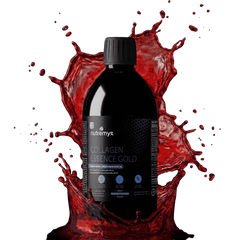
12,500 mg of hydrolyzed marine collagen, retinol, and hyaluronic acid in liquid formulation. European manufacturing certified GMP, HACCP, ISO 22000. Up to 3 times higher bioavailability than capsules.
See Collagen Essence Gold FormulationScientific References
- Proksch E, Segger D, Degwert J, Schunck M, Zague V, Oesser S. Oral supplementation of specific collagen peptides has beneficial effects on human skin physiology. Skin Pharmacol Physiol. 2014;27(1):47-55.
- Clark KL, Sebastianelli W, Flechsenhar KR, et al. 24-Week study on the use of collagen hydrolysate as a dietary supplement in athletes with activity-related joint pain. Curr Med Res Opin.
- Hexsel D, Zague V, Schunck M, Siega C, Camozzato FO, Oesser S. Oral supplementation with specific bioactive collagen peptides improves nail growth and reduces symptoms of brittle nails. J Cosmet Dermatol.
- Oesser S, Adam M, Babel W, Seifert J. Oral administration of 14C labeled gelatin hydrolysate leads to an accumulation of radioactivity in cartilage of mice. J Nutr. 1999;129(10):1891-1895.
- Varani J, Dame MK, Rittié L, et al. Decreased collagen production in chronologically aged skin. Am J Pathol. 2006;168(6):1861-1868.
- ANSES. Risk assessment related to the consumption of food supplements containing collagen. Opinion of the French Agency for Food, Environmental and Occupational Health & Safety. 2019.
- European Food Safety Authority (EFSA). Safety of collagen and gelatine from conventional food sources. EFSA Journal. 2005;313:1-28.
- Hexsel D, Zague V, Schunck M, Siega C, Camozzato FO, Oesser S. Oral supplementation with specific bioactive collagen peptides improves nail growth and reduces symptoms of brittle nails. J Cosmet Dermatol.
This article is for informational purposes only and does not replace medical advice. If you are taking medication or have a specific health condition, consult your doctor before starting any supplementation.
The information shared on this blog is for educational and informational purposes only. It does not replace medical consultation, diagnosis or treatment prescribed by a healthcare professional. If you have symptoms, are undergoing treatment or are pregnant, consult your doctor before modifying your diet or starting supplementation. Nutremys LAB food supplements should not replace a varied, balanced diet or a healthy lifestyle.
