

En un coup d'œil
- Les phytoestrogènes sont d'origine végétale — isoflavones (soja, trèfle rouge), lignanes (lin), coumestanes
- Leur activité œstrogénique est 10 à 1 000 fois plus faible que l'estradiol humain
- Le THS utilise des hormones synthétiques ou animales qui remplacent directement vos œstrogènes
- Les phytoestrogènes modulent les récepteurs — effet adaptatif selon le tissu (os, cerveau, muqueuses)
- Les femmes japonaises consomment 25–50 mg/jour d'isoflavones via l'alimentation traditionnelle
- L'EFSA juge les isoflavones sûrs jusqu'à 150 mg/jour chez la femme ménopausée en bonne santé
Sommaire
Qu'est-ce qu'un phytoestrogène ?
Le terme peut sembler intimidant. Il s'agit pourtant d'un concept simple : les phytoestrogènes sont des composés présents naturellement dans certains végétaux qui, une fois ingérés, interagissent avec les récepteurs aux œstrogènes de votre organisme. « Phyto » vient du grec et signifie plante.
Ce qui les distingue fondamentalement des hormones humaines, c'est leur structure moléculaire légèrement différente et — surtout — leur affinité bien plus faible pour les récepteurs. En pratique, leur activité œstrogénique est estimée entre 10 et 1 000 fois inférieure à celle de l'estradiol produit par vos ovaires.

Les trois grandes familles de phytoestrogènes
Comment agissent-ils sur vos récepteurs ?
Vos cellules possèdent deux types de récepteurs aux œstrogènes : ERα (présent surtout dans l'utérus, le sein, le foie) et ERβ (présent dans les os, le cerveau, les vaisseaux, les intestins). L'estradiol naturel se lie fortement aux deux. Les phytoestrogènes, eux, ont une préférence marquée pour ERβ — ce qui explique leur profil d'action différent et, selon les spécialistes, leur meilleur profil de sécurité dans les tissus sensibles.
« La sélectivité des phytoestrogènes pour ERβ est au cœur du débat scientifique sur leur sécurité. C'est précisément cette préférence qui les distingue du THS et qui oriente la majorité des recherches actuelles sur la phytothérapie ménopause. »
Phytoestrogènes vs hormones synthétiques : la différence fondamentale
La confusion entre ces deux catégories est fréquente — et compréhensible. Deux substances qui agissent sur les mêmes récepteurs ne sont pourtant pas équivalentes. Voici pourquoi.
Le THS : un remplacement hormonal direct
Le traitement hormonal de substitution (THS) — désormais appelé traitement hormonal de la ménopause (THM) en France — consiste à administrer des hormones exogènes pour compenser la chute hormonale liée à la ménopause. Ces hormones sont soit synthétiques (éthinylestradiol, acétate de médroxyprogestérone), soit d'origine animale (estrogènes conjugués équins). Leur mécanisme : se substituer directement à votre production ovarienne défaillante, en activant pleinement les récepteurs ERα et ERβ.
Le THM est efficace sur les symptômes sévères. Il est également associé à des risques documentés : selon l'étude Women's Health Initiative (JAMA, 2002), des doses élevées d'estrogènes + progestatifs synthétiques augmentent légèrement le risque de cancer du sein et d'événements cardiovasculaires chez certains profils de patientes.
Les phytoestrogènes : un effet modulateur, pas un substitut
Les phytoestrogènes ne remplacent pas vos hormones. Ils modulent vos récepteurs selon un mécanisme appelé SERM végétal (modulateur sélectif des récepteurs aux œstrogènes d'origine naturelle). Selon le tissu et le niveau hormonal ambiant, ils peuvent exercer un effet légèrement activateur ou légèrement bloquant — un comportement adaptatif que les hormones synthétiques ne reproduisent pas.
L'Autorité Européenne de Sécurité des Aliments a conclu que les isoflavones de soja à des doses allant jusqu'à 150 mg/jour ne présentent pas de risque pour la santé de l'os, de la thyroïde ou de l'endomètre chez les femmes ménopausées saines.
Ce que dit la science sur les isoflavones et la ménopause
Les isoflavones de soja et de trèfle rouge sont les phytoestrogènes les plus documentés dans le contexte de la ménopause. Plusieurs décennies de recherche permettent aujourd'hui de dresser un bilan nuancé.

Bouffées de chaleur : les études clés
Une revue Cochrane portant sur 43 essais cliniques randomisés (Lethaby et al., 2013) a conclu que les isoflavones réduisent la fréquence des bouffées de chaleur d'environ 17 % par rapport au placebo, avec une réduction de leur intensité également observée. L'effet est modeste mais reproductible — et particulièrement marqué chez les femmes présentant plus de 5 bouffées de chaleur par jour.
Une méta-analyse publiée dans Menopause (2012) portant sur 19 études a confirmé cette tendance, notant que l'efficacité des isoflavones est dose-dépendante et individuelle : certaines femmes sont des « métaboliseurs actifs » d'équol (un métabolite de la daidzéine) qui bénéficient davantage des isoflavones que d'autres.
La population japonaise : un exemple naturel observationnel
Les femmes japonaises traditionnelles consomment entre 25 et 50 mg d'isoflavones par jour via le tofu, le miso et l'edamame. Leur prévalence de bouffées de chaleur sévères à la ménopause est historiquement inférieure à celle des femmes occidentales — un constat observationnel (pas causal) qui a alimenté l'intérêt scientifique pour ces molécules depuis les années 1990.
🦴 Densité osseuse
Plusieurs études montrent que les isoflavones contribuent à maintenir la densité minérale osseuse après la ménopause, via leur action sur les récepteurs ERβ des ostéoblastes (cellules de formation osseuse).
💧 Sécheresse vaginale
Des études en supplémentation orale montrent une amélioration des muqueuses vaginales, avec un effet bénéfique sur l'atrophie urogénitale légère à modérée.
❤️ Santé cardiovasculaire
Une revue de l'EFSA (2015) note une tendance à l'amélioration du profil lipidique (LDL, HDL) avec une supplémentation régulière en isoflavones, sans effet délétère sur la pression artérielle.
🧠 Humeur et cognition
Des études exploratoires suggèrent un effet bénéfique sur l'humeur et la mémoire verbale en périménopause, via les récepteurs ERβ du cerveau. Les données restent préliminaires mais prometteuses.
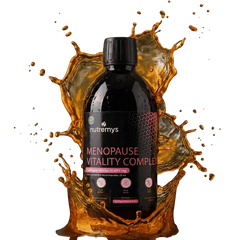
Isoflavones de soja et trèfle rouge dans Menopause Vitality Complex
Le Menopause Vitality Complex Nutremys contient, parmi ses 14 actifs cliniquement dosés, deux phytoestrogènes végétaux :
- Isoflavones de soja — 2 mg par dose journalière
- Extrait de trèfle rouge (Trifolium pratense) — 2 mg par dose journalière
Ces doses s'inscrivent dans une logique de complémentation douce et synergique — elles ne sont pas conçues pour reproduire un THS, mais pour soutenir l'équilibre hormonal naturel de la transition ménopausique dans le cadre d'une formule globale.
"Sans hormones synthétiques" ≠ "sans phytoestrogènes"
Sur l'emballage du Menopause Vitality Complex, vous lisez : « sans hormones synthétiques ». Ce claim est précis et sincère : la formule ne contient aucun estrogène de synthèse (éthinylestradiol, estrogènes conjugués équins) ni progestatif de synthèse. En revanche, elle contient bien des phytoestrogènes d'origine végétale — et nous l'assumons pleinement.
Les isoflavones de soja et l'extrait de trèfle rouge sont des ingrédients végétaux dont les bénéfices sont documentés par la science. Les inclure dans notre formule est un choix délibéré et assumé — pas une ambiguïté à masquer. « Sans hormones synthétiques » et « contient des phytoestrogènes naturels » sont deux réalités complémentaires, pas contradictoires.

Pourquoi ces ingrédients à dose complémentaire ?
À 2 mg chacun, ces phytoestrogènes s'inscrivent dans une logique différente de la supplémentation à haute dose en isoflavones (généralement 40–80 mg dans les études cliniques). L'objectif est d'activer les récepteurs ERβ en synergie avec les autres actifs de la formule : collagène marin, vitamine D3, magnésium bisglycinate, zinc, et complexe B. C'est l'approche holistique qui caractérise la philosophie Nutremys : pas de « pilule miracle isolée », mais une formule où chaque actif renforce les autres.
Précautions : qui doit être vigilant avec les phytoestrogènes ?
Les phytoestrogènes sont bien tolérés par la grande majorité des femmes. Il existe cependant des situations où une vigilance médicale s'impose avant toute supplémentation.
| Situation | Niveau de vigilance | Recommandation |
|---|---|---|
| Femme ménopausée en bonne santé | ✅ Faible | Pas de contre-indication aux doses complémentaires standards |
| Antécédents de cancer hormono-dépendant (sein, endomètre) | ⚠️ Élevée | Consultation médicale obligatoire avant toute supplémentation en isoflavones |
| Hypothyroïdie traitée par lévothyroxine | ⚠️ Modérée | Prendre le médicament 2–3 h avant ou après le complément contenant des isoflavones |
| Allergie au soja avérée | ⚠️ Élevée | Éviter les compléments à base d'isoflavones de soja ; consulter avant usage |
| Grossesse ou allaitement | ⛔ Contre-indication | Compléments phytoestrogènes déconseillés par précaution |
Cancer hormono-dépendant : la position des experts
La position de la Société Européenne de Ménopause et d'Andropause (EMAS) et de l'EFSA est aujourd'hui nuancée : il n'existe pas de preuve que les isoflavones à des doses alimentaires ou complémentaires standards augmentent le risque de cancer du sein dans la population générale. Les populations asiatiques à forte consommation de soja présentent même des taux de cancer du sein historiquement inférieurs à ceux des populations occidentales — sans que la causalité soit établie. Toutefois, en cas d'antécédent personnel ou familial de cancer hormono-dépendant, la consultation médicale reste impérative.
Hypothyroïdie et isoflavones de soja
Les isoflavones de soja peuvent réduire l'absorption intestinale de la lévothyroxine sodique (Levothyrox®, Euthyrox®). Si vous suivez un traitement thyroïdien, il suffit de respecter un intervalle de 2 à 3 heures entre votre médicament et votre complément contenant des isoflavones. Cette précaution simple suffit dans la grande majorité des cas.
Cet article est à titre informatif et ne remplace pas un avis médical personnalisé. En cas de doute sur votre situation de santé, consultez votre médecin ou gynécologue avant de commencer toute supplémentation.
Questions fréquentes sur les phytoestrogènes
Sources scientifiques
- Lethaby A. et al. — Phytoestrogens for menopausal vasomotor symptoms, Cochrane Database Syst Rev, 2013 — Cochrane Library
- EFSA Panel on Food Additives and Nutrient Sources — Risk assessment for peri- and post-menopausal women taking food supplements containing isolated isoflavones, EFSA Journal, 2015 — efsa.europa.eu
- Writing Group for the WHI Investigators — Risks and Benefits of Estrogen Plus Progestin in Healthy Postmenopausal Women, JAMA, 2002 — PubMed
- Messina M. — Soy and Health Update: Evaluation of the Clinical and Epidemiologic Literature, Nutrients, 2016 — PubMed
- Williamson-Hughes P.S. et al. — Isoflavone supplements containing predominantly genistein reduce hot flash symptoms, Menopause, 2006
- Usui T. — Pharmaceutical prospects of phytoestrogens, Endocrine Journal, 2006
Formulé avec soin. Transparent par conviction.
Le Menopause Vitality Complex associe 14 actifs cliniquement dosés — dont des isoflavones naturels, du collagène marin et de la vitamine D3 — pour accompagner votre ménopause avec sincérité.
Découvrir la formule complèteLes informations partagées sur ce blog sont à titre éducatif et informatif. Elles ne remplacent en aucun cas une consultation médicale, un diagnostic ou un traitement prescrit par un professionnel de santé. Si vous présentez des symptômes, suivez un traitement ou êtes enceinte, consultez votre médecin avant de modifier votre alimentation ou de débuter une supplémentation. Les compléments alimentaires Nutremys LAB ne sauraient se substituer à un régime alimentaire varié et équilibré, ni à un mode de vie sain.

